Friday, July 12, 2013

The 2nd annual Peru to the World Expo


(image via prweb)

If you are a foodie you already know that Peruvian food is undergoing something of a renaissance. Peruvian cuisine has influences of all the peoples that have influenced its past, including China, Asia, Africa, Italian and, of course the indigenous culture. perhaps that is why eating Peruvian food is such an amazing experience, because it contains so many cultural staples.

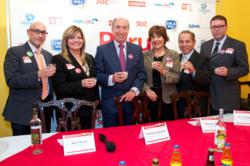
This Tuesday past a press conference was held at the Consul of Peru uptown announcing the second annual Peru to the World Expo. Attending the event was Her Excellency, Maria Teresa Merino de Hart, Conrad O. Falco, from the Commercial Office of Peru in New York, Melvi Davilla, the event coordinator and attorney Antonio Guttierez as well as members of cultural and food press. This year the event will be held in Manhattan -- last year it was held in New Jersey. The national drink, Pisco sours -- a grape based brandy, lime juice, egg whites and bitters -- were served as well as some amazing Peruvian fare.

The 2nd annual Peru to the world expo begins tomorrow and Sunday at 11 am to 6 PM at the Altman Building on 135 W. 18th street. There will be live cooking demonstrations from some of the finest Peruvian inspired chefs in the country, including Danny Kou of El Rocoto, LA, Marita Lynn of Runa, Red Bank, NJ, Miguel Garcia of the Ritz-Carlton, DC, and Javier Flores of Aromas de Peru, Miami. Attendees will be able to taste a lot of the amazing food and afterwards there is a dance party.

This year's event celebrates the United Nations International year of Quinoa -- also known as Amaranth, the super grain -- so there will probably be lots of cooking demonstrations with chefs demonstrating quinoa based dishes.

Tickets purchased online are $25, and $30 at the door. Children under 6 get in for free. See you there; we'll have some Pisco sours.

Thursday, July 11, 2013

Media-Whore D'Oeuvres


"It has been a source of contention between the United States and Pakistan since the 2011 raid in which Navy SEALs killed Osama bin Laden: How could the world's most wanted fugitive hide in a country that was supposed to be committed to catching him? The relationship between the two nations was sour before the raid—U.S. authorities didn't notify Pakistan about the bin Laden raid for fear of alerting the target—and the humiliation of the armed action damaged the relationship even further. 'We think that there had to be some sort of support network for bin Laden inside of Pakistan,' President Obama said in an interview on 60 Minutes shortly after the raid. The week after the raid, Pakistani president Asif Ali Zardari said that Americans "have suggested that Pakistan lacked vitality in its pursuit of terrorism or, worse yet, that we were disingenuous and actually protected the terrorists we claimed to be pursuing. Such baseless speculation may make exciting cable news, but it doesn't reflect fact.'  Two years later, more details about exactly how Pakistan could have missed bin Laden are coming to light. The Pakistani government formed a commission to study how bin Laden could have lived unnoticed in Pakistan. Within that report, newly leaked to Al Jazeera, are details about Abbottabad, the city where bin Laden was found, and the public officials who police it. The report concludes that gross incompetence led to the failure to detect bin Laden. But there is also plenty of fodder indicating that local law enforcement were content to leave the strange building and its unseen occupants alone despite some prominent red flags, while it seems Pakistan's national intelligence agencies ignored the signs the al-Qaida leader was present." (PopularMechanics)


"In the aftermath of Barack Obama’s relatively comfortable reelection victory in 2012 — a win fueled by massive margins among African Americans, Hispanics and other nonwhite voters — an intense debate has begun among Republican leaders and strategists over the future direction of the party. The GOP has now lost the national popular vote in five of the last six presidential elections. Yet according to national exit polls, Republican candidates won the white vote by double-digit margins in the last four of these elections, including a 20-point margin in 2012. Given these results, some prominent Republican strategists, including Karl Rove, believe that the key to the party’s future viability in presidential elections is finding ways to increase its share of the growing nonwhite vote. Since 1992, according to national exit polls, the nonwhite share of the electorate has increased from 13% to 28%, and this trend is almost certain to continue for many years to come. Based on census data, the voters who will be entering the electorate over the next few decades will include a much larger proportion of nonwhites, and especially Latinos, than the voters who will be leaving the electorate. But not all GOP strategists agree with the approach advocated by Rove and his allies or with the necessity of increasing the party’s share of the nonwhite vote in order to achieve success in future presidential elections. In a recent series of posts at RealClearPolitics.com, analyst Sean Trende has argued that Republicans can effectively compete in future presidential elections without substantially increasing their support among Hispanics and other nonwhite voters by focusing on increasing turnout and support among white voters, who will continue to make up the large majority of the American electorate. Trende’s argument that the GOP can achieve success by, essentially, doubling down on white voters rests largely on an analysis of racial voting patterns in presidential elections over the past several decades. According to Trende, Republicans have significantly increased their performance among white voters over time. If this trend continues, he argues, given a reasonably favorable political and economic environment, Republican candidates should have a good chance of overcoming the Democratic advantage among nonwhite voters in future presidential elections." (CenterforPolitics)


"The pilot then hooked a right and headed up the coast. The purpose of this flight was to check out the beach erosion that’s affecting Malibu, Los Angeles’s most expensive and storied summertime playground. A town of less than 13,000, sandwiched between the sea and the vertiginous cliffsides of the Santa Monica Mountains, it has only one main road, the Pacific Coast Highway, but is stuffed with homes owned by what seems like half of Hollywood’s power brokers and stars—from Courteney Cox’s five-bedroom midcentury on the beach, bought for $17 million, to Cher’s Italian Renaissance mansion, with hand-carved marble details and stamped copper ceilings, which is quietly on the market for $41 million. 'California beaches are more temperamental than on the East Coast, but mercifully, in most places, development is much further inland,' says Costas Synolakis, an environmental engineering professor at the University of Southern California. That’s not the case in Malibu, though, where many of the best houses are literally built on sand dunes. Soon, the Beechcraft was flying over one of Malibu’s premier neighborhoods, the one-and-a-half-mile-long Carbon Beach, also known as 'Billionaire’s Beach.' Oracle C.E.O. Larry Ellison, the country’s third-richest man, has been madly snapping up properties there, including nine homes for which he spent at least $140 million and the building that houses the recently reopened Malibu outpost of Nobu, one of the area’s few flashy oceanfront restaurants, where patrons sit on plush couches next to fireplaces. As the plane passed over the restaurant, one could see that the valet had color-coded the cars—the black ones on one side of the lot, the white on the other, with the tan and silver ones clumped together, and a small pocket reserved for outliers like red vintage Aston Martins and yellow Lamborghinis. Ford spotted some erosion on Carbon Beach. Kids were playing down there, but the beach was not voluminous. 'Not great over here,' he noted. But this was nothing compared with what was to come, in Malibu’s other premier neighborhood: Broad Beach. The plane nudged up the coast, passing Julia Roberts’s $20 million eco-friendly compound and Barbra Streisand’s four-home lot (main house, millhouse, barn, and 'grandma’s house') estimated to be worth as much as $100 million, both of which—lucky for them—are somewhat protected by a large bluff, and eventually made its way around Point Dume, a rocky outcropping that marks the shift from a primarily south-facing beach to one angled west." (VanityFair)


"It's been just over six months since we said goodbye to 2012 and hello to 2013, and already we've seen a slew of promising indie talent breakthrough in big ways thanks to the Sundance, SXSW and Tribeca film festivals (among many others), and theatrical releases that caught on with the movie-going public. Over the past two days we've been publishing our picks for this year's biggest indie breakthroughs so far (we still have half a year to go), with our reasons for why they made the cut and info on what they're up to next. Below find the full list, including two new inclusions who made a huge dent at this year's Cannes Film Festival." (IndieWIRE)


"ENDQUOTE: 'There’s eventually going to be a big meltdown. You’re going to end up with fewer theaters. Going to the movies will cost 50 bucks or 100 or 150 bucks, like what Broadway costs, or a football game.' George Lucas made that dire prediction at a panel discussion at the University of Southern California last month. And in fact soon after, Paramount offered a 'mega' ticket to those who wanted to see 'World War Z' in advance. This cost $50. Not only did you get to see the zombie flick, you also received a digital copy of the movie, a poster, a small popcorn. Whether it is the wave of the future, nobody knows for sure, not even Entertainment Weekly magazine, which reported on this. EW says: 'At this point Americans don’t seem sold on the idea of paying more for tickets to in-demand flicks.' But more cynical show-biz types counter: 'You know the schumcks who line up two days in advance for a ‘Harry Potter’ movie or a ‘Twilight’ movie? They’re going to pay the extra money.'" (NYSocialDiary)

Wednesday, July 10, 2013

Media-Whore D'Oeuvres


"He was the invisible man of the 2012 campaign, not to mention most of President Barack Obama’s first term. Yet in recent weeks, former President George W. Bush is having a resurgence: He’s speaking out on immigration reform and AIDS in Africa and gingerly addressing the gay marriage debate. And in a twist few would have predicted even six months ago, Bush’s public approval rating recently eclipsed Obama’s. His supporters insist he has no strategy, no master plan for public re-entry. But the Republican who left the White House amid two unpopular wars and with few fans in either party appears to be in the early stages of settling into the role of elder statesman, on his own terms. On Wednesday, Bush spoke at a citizenship ceremony event at his just-opened presidential library in Dallas — as House lawmakers on the same day were set to take up the rancorous topic of immigration reform. 'We are a nation of laws, and we must enforce the laws,' he said, according to the Dallas Morning News. 'But we have a problem. The laws governing our immigration system are not working. The system is broken.” Bush called for a 'positive resolution' to the debate in Congress. The 43rd president has spent most of his post-White House life in self-imposed political exile, staying at his home in Texas and far away from Washington, a world he never really took to. He endorsed Mitt Romney through the closing doors of an elevator. And Bush remained quiet as a backlash within his party — triggered largely by government spending on his watch — gave rise to the tea party movement, the effects of which have lingered throughout Obama’s presidency." (Politico)


"The talk (where there is talk) of current events in the city are the candidacies of Anthony Weiner and Eliot Spitzer. Mr. Weiner is running for Mayor and Mr. Spitzer has announced that he will run for city comptroller.  The media is playing it up as a kind of duo au scandale, since both men found/accidentally came upon notoriety (quite unintentionally) in their private lives.  If you don’t know what I’m talking about, it doesn’t matter because both situations were an opportunity for the public to allow itself to be distracted once again from what’s really going on in our culture, our society. Business as usual. Mr. Weiner is famous for having exposed himself physically through the wonders of modern technology. It is a peculiar activity, that former activity of Mr. Weiner. At least to me. However, it is also quite commonplace to a lot of other people. Hundreds of thousands, maybe millions (who knows) across the world are into exposing themselves physically on the web to anyone who really needs to look. And evidently there are lots of those out there too. I’ll bet there are even some or quite a few  who need  to look who also think Mr. Weiner is a terrible man. I don’t know him; I don’t know what to think. One thing you can say about him is he’s very much a man of his generation. I don’t know what to think of a lot of it. We’ll find out later, I’m sure. Mr. Spitzer, who is older by a few years, had the old classic kind of sex scandal. He was exposed by the powers that be whose financial chicanery was well on its way to being exposed by Mr. Spitzer. Checkmate. Actually, aside from his personal private activities, Mr. Spitzer had the public good in mind in his work. That’s actually what got him elected governor. However, the good public drops everything when they hear about any kind of extra-marital liaison that a public figure is having. The idea being that public figures should be pure and holy.  At least the reformers. I’m not suggesting that these things are not important because they are ... to the individuals involved and no one else. We already know many if not most politicians are into some kind of hanky-panky and/or are corrupt. That's why they sit at the bottom of all respectability polls, duh. People (or at least the mainstream media) pretend it’s one party and not the other. Well, it’s people. It’s us.As far as sex goes, the internet has changed the public attitude, especially for the younger generations. Children are looking at this stuff on the internet, and unsupervised. Period. Forget about thinking how can you stop it because the genie is out of the bottle." (NYSocialdiary)


"The long lazy summer is upon us, and as I walk the Swiss hills below the mountain ranges my thoughts are always of the past. I think of long hot summers of long ago: girls in their pretty dresses and my father in his whites sailing around the Saronic Bay with a ball-and-chain standard flying from his main mast. It meant “Wife Onboard,” which really meant that when he dropped anchor on some nearby port, local talent should stay away. Dad was famous—infamous, rather—for flying that ensign, because he loved partying with loose women on his boat, and during the rare occasions my mother would come onboard, he didn’t want to embarrass her with the inevitable visitors coming around. After his death I would drop anchor in different islands and people would ask what happened to the flag. 'Unlike my father, I am monogamous,' I’d lie, and they’d invariably answer, 'If only you could be half the man he was.…'" (Taki)


"Cressida Bonas was first romantically linked to Prince Harry in mid-2012, several months after he broke up with on-again, off-again girlfriend Chelsy Davy. They have never appeared together in any official capacity, nor been photographed together (they always arrive and leave clubs, weddings, and other events separately), but they have a knack for showing up at the same places at the same times, and have accompanied one another on ski trips and tropical vacations. Tabloids say things cooled after Harry's misadventures in Vegas last year, but now things seem to be on stronger than ever — they were recently seen partying at Glastonbury, and over the weekend they attended a Mumford & Sons concert in London.  Cressida is described by friends as 'very discreet,' which explains the dearth of information about her on the Internet." (NYMag)


"How to Be a Playgirl, a Barnes and Noble Nook Snap by Mental Floss editor Jessanne Collins, is a short—just 24 pages—and highly readable recounting of the highlights of her year-long experience as an editor of Playgirl magazine. Playgirl 'debuted in the summer of 1973 and was billed as a sex-positive, fun-oriented feminist response to Hugh Hefner's empire'; when Collins started there in 2007 and until it shuttered in 2008, it bore only a slight resemblance to the original. In a recent two-hour conversation, Collins and I pored over the covers of select issues of Playgirl. It’s a fascinating journey to go from the first issue, in which editor Marin Scott Milam defined 'a Playgirl' as 'independent, self-confident, aware, involved, adventurous, daring, curious, vital, ambitious, sensuous, loving, giving, alive, liberated, free,' to the magazines of the late-aughts featuring increasingly greasy, provocatively posed 'hunks.' They reveal much about women, men, magazines and magazine design, and, not least, the evolution of Playgirl, and how we think about sex, too." (TheHairpin)


"At the height of her career, the New York Times called Luna 'a stunning Negro model whose face had the hauteur and feline grace of Nefertiti.' The designer Stephen Burrows recalled that 'she was just one of those extraordinary girls.' And in 1966, when Beatrix Miller, the editor of British Vogue, chose her as the first-ever black model for that magazine’s cover, it was because of 'her bite and personality.' Bethann Hardison, another ascendant model, remembers that, 'no one looked like her. She was like a really extraordinary species.' Soon, Luna became one of the first black models to attain superstar status in Europe, photographed by the legendary photographer David Bailey, famed for his images of the Beatles and the Rolling Stones. David McCabe, known for photographing celebrities like Twiggy and Andy Warhol, recognized that Luna had something special the first time he saw her in 1963. 'I was on a photo assignment in Detroit, photographing Ford cars [and] there was a school nearby,' he recalled. 'I was struck by this almost 6-foot-tall beautiful girl – around 14-years-old at the time – wearing her Catholic uniform. She stopped to see what was going on.' He told her that he was a photographer for magazines like Mademoiselle and Glamour and that, if she was ever in New York, she should call him. In 1964, he got that call, and sent the ensuing photos to various agencies. 'I also called Richard Avedon,' he remembers. 'I said you’ve got to see this girl. She’s just unbelievable.' Soon Avedon began photographing her, too, eventually signing her to a one year contract." (NYMag)

Monday, July 08, 2013

Mos Def Being Force Fed Gitmo Style

Media-Whore D'Oeuvres


"Now here’s a comeback that seems to make sense. Eliot Spitzer has spent a significant amount of time in political purgatory: Five years have passed since he was caught in a prostitution scandal and resigned as governor. He appears to have gotten his priorities in order: first trying to repair relations with his wife and daughters, then reemerging as a commentator, mostly on serious issues in which he has an expertise. Sure, Spitzer’s turns as a host on CNN and Current TV were ratings duds, but he mostly elevated the dialogue, and his time as a NY1 'Wiseguy' showed he’d become better at mixing in some humor. And his columns for Slate, especially about the financial crisis and the federal bailout, were smart and fiery plutocrat-populist reminders of what had made Spitzer so good as state attorney general. Those skills, in turn, match well with the office he suddenly wants to win: city comptroller. Yet actually winning, in a Democratic primary against current Manhattan borough president Scott Stringer, is going to be difficult. The timing of his last-minute decision — six weeks after Anthony Weiner's success at launching a viable campaign — means that throughout the election season Spitzer’s sins will be measured against those of the disgraced former congressman. In legal terms, there’s no contest: Spitzer committed adultery and possibly broke interstate sex trafficking laws. Weiner tweeted photos of his penis and his bare chest — egregious violations of judgment, but probably not actionable. The moral and political trespasses, though, are significantly tougher to weigh, and the standards are highly subjective. The rough consensus is that Spitzer’s acts were (very slightly) more sane, Weiner’s more twisted; Spitzer’s transgressions more offensive, Weiner’s sillier. Yet the political damage, then and now, is clearly worse for Spitzer: He’d become a star as a prosecutor, and won a landslide victory in the 2006 race for governor, on his record and reputation for rectitude. He was going to clean up Albany, but instead antagonized allies and infuriated enemies before diving into his own cesspool, blowing a major chance to straighten out the state. Weiner was merely one of 435 in Congress — good at drawing attention to hot-button issues and to himself, but ineffective at passing legislation. Part of why voters seem willing to forgive Weiner is that he was playing for lower stakes." (NYMag)


"Years ago, when I was recently divorced, I met a sexy bass player with an overwhelming desire to be a rock star. Knowing nothing about the music industry, I said, 'No problem,' and transformed myself into his agent. I phoned everyone I knew with even the slightest connection to the production of sounds. Due to my surname I can get a meeting with anyone, once. I soon discovered there was little good that could be achieved by merely blathering on about some song. It was obvious what had to be done, so I produced a music video. Manhandling my friends I corralled one producer, one camera operator, one assistant to set up and hold the boom-box while we flitted about Central Park shooting my hot ass boyfriend and his bandmates crooning in various positions near the fountain, crossing the humped bridge, etc, and once we had our footage I even begged time (nights and bump-able) from a pal with a professional editing bay. A few days later, along with $500 and the trammeled goodwill of pals a music video was born. A miniature movie with the boyfriend’s music and handsome face featured. Something tangible at last to foist while pitching. It was a critical component and armed with copies of these marvels I marched into the offices of the late Ahmet Ertegun, the late Bill Paley, music critics, music makers, and anyone else I could reach. Inevitably one connection led to another and eventually someone said, 'You need to meet Nile Rodgers. Nile will know if your music is any good. I will call him and ask him to meet you.' I reported back to the boyfriend and he fainted when I announced I had a connection to some music dude named Nile Rodgers. I placed a call and explained my plight and Nile promptly invited me over to the Sound Factory studio. I hopped on the subway and found this Sound Factory in an unremarkable building in an industrial section of town. I pressed a button and was buzzed into a waiting room like an Incan vault of plush red with tall walls bespattered with framed LPs seemingly made of gold.  Before too long a door I had not noticed opened and out strode a man dressed in leather pants and shoulder length dreads. He smiled somewhat shyly as he approached me, 'I’m Nile,' he said, and offered a hand for me to shake.
I stood up and took the proffered hand. I liked him immediately. 'Sorry to keep you waiting,' he began. 'But I’ve got the B-52s in there,' and he swung his dreads in the direction of the door. 'We’re in the middle of recording, so I can’t stay too long. How I can help you?'" (Christina Oxenberg)


"On September 11, 2012, heavily armed Islamic militants attacked the compound of the U.S. Special Mission in Benghazi, Libya, and later a nearby C.I.A. Annex, leading to the death of four Americans, including U.S. ambassador J. Christopher Stevens. This set off a firestorm here at home as Republicans scrambled to make political hay from Stevens's death, charging that Hillary Clinton's State Department had done little to protect him and the mission and that State and the White House had conspired to minimize the incident's election-year impact. Investigations were launched in the Senate, in the House of Representatives, by the F.B.I., and by the Obama administration—and still more investigations are being called for. For all the soul-searching and finger-pointing surrounding that night in Benghazi, the details of what actually happened have remained murky, at best.
In '40 Minutes in Benghazi,' beginning on page 90, Fred Burton, a former State Department deputy counterterrorism chief, and Middle East expert Samuel M. Katz tell the narrative of this American tragedy in heart-stopping, minute-by-minute detail. The authors, whose book on the raid, Under Fire: The Untold Story of the Attack in Benghazi, will be published in September, had unprecedented access to confidential sources within the diplomatic, intelligence, and military communities. They have used this trove of information to show not only how the system worked but also how Ambassador Stevens and the diplomatic-security agents assigned to protect him responded heroically as they were overwhelmed by extraordinary events. It is much more a tale of valor on the ground than a story about the overshadowing grandstanding we've witnessed from those in Washington's bleachers." (Graydon Carter)

Resolved: Jay Z is Getting Truly Obnoxious


via fader

Saturday, July 06, 2013

Media-Whore D'Oeuvres


"For the last decade or so, Vali Nasr has published original, pragmatic work about Middle Eastern politics. The Shia Revival, his 2006 book, confidently mapped how the Bush administration’s invasion of Iraq strengthened Iran and reanimated sectarian conflict in the Arab world and beyond. Forces of Fortune followed three years later; it described presciently the potential of Arab middle classes just before Tunisian, Egyptian, and Libyan urbanites helped ignite the “Arab Spring.” By that time Nasr had entered the State Department as a senior adviser to Ambassador Richard Holbrooke, whom President Obama appointed as a special representative to Afghanistan and Pakistan. After Holbrooke died suddenly in December 2010, Nasr left the State Department and in 2012 became dean of the Paul H. Nitze School of Advanced International Studies at Johns Hopkins University in Washington.In The Dispensable Nation, Nasr dissects what he regards as the overlapping failures of the Obama administration’s foreign policies across the Middle East and South Asia, from Pakistan to Iran to revolutionary Egypt. The book begins as a detailed, analytical memoir of disappointment over how “a small cabal of relatively inexperienced White House advisers” undermined Holbrooke’s diplomatic mission in South Asia, as Nasr looked on. The author then embarks on a withering review of first-term Obama administration diplomacy.He concludes with criticism of Obama’s most important foreign policy conception, the announced American “pivot” toward Asia and away from the Middle East, a reorientation of policy, alliance priorities, and military deployments made possible by the reduction of American involvement in the wars Obama inherited in Iraq and Afghanistan. Most provocatively, Nasr argues that by retreating from the Middle East—and by signaling a withdrawal from “the exuberant American desire to lead in the world”—Obama has yielded strategic advantage to China, for which the United States will pay a heavy price in the future." (NYRB)

"Meredith Whitney arrived early for lunch at the Wolseley and so, alas, I didn’t see Wall Street’s most notorious analyst making her entrance. I bet the other diners stared, though. They may not have known that this was the woman who predicted the US banking crisis but they couldn’t have failed to clock her fishnet-clad legs, one ending in a patent leather high-heeled shoe with a diamante buckle, the other in a blue-and-pink trainer. When I get there, the portion of Whitney visible above the starched white tablecloth looks exactly as a woman known as the 'dollar dominatrix' ought to. A long position in gold is festooned around her neck and clamped to her ears; her hair is big and blonde and her sweater black and expensive. Yet the smile is warm and girly. Please like me, it begs. 'This is so nice of you. I’m so excited about this!' she says in a voice so low that I can barely hear it above the din of the restaurant. Whitney can afford to whisper: people go to great lengths to listen to what she has to say, even if they sometimes regret it afterwards. In 2007 she predicted that Citibank would cut its dividend – and it did. But then in 2010 she predicted that 50 to 100 municipal bonds would default – and they didn’t. Call #1 had Michael Lewis saying she was 'the closest thing Wall Street has to an oracle'. Call #2 had Fox TV commentator Charlie Gasparino saying she 'didn’t possess a single brain cell' ...It is odd how cross people are with Whitney about that municipal bond call she made two and a half years ago. Her initial bearish view was shared by such financial luminaries as Bill Gross and Nouriel Roubini; she only departed from them by being specific and saying defaults would run into hundreds of billions dollars within a year. When the defaults didn’t happen, she made everyone even crosser by declining to say sorry. Now she has written a book justifying her position. In it she argues that the coastal states that were hardest hit by property collapse will suffer a mass exodus as people flee from regulation, debt and punitive taxation, moving to the 'flyover” states in the middle where taxes are lower." (FT)


"Egypt's Tamarod movement succeeded in its attempt to pressure the Egyptian military to expel former President Mohammed Morsi and his Muslim Brotherhood-led government from office. Now the question is whether Tamarod and the other elements of the former opposition can avoid the kind of fragmentation and divisive infighting that played a significant role in catapulting the Muslim Brotherhood to power in the first place. There are many challenges to overcome, not the least of which is that the military ultimately holds the keys to power -- something the Muslim Brotherhood learned the hard way July 3. Going forward, it will be difficult for the disparate blend of liberal, secular and Islamist parties united in their shared desire to see Morsi deposed to maintain their cohesion. The Tamarod movement declared its existence and demands on May 1, and a little more than two months later it had gathered enough momentum to play a critical role in Egypt's military coup. The military essentially fulfilled all of Tamarod's demands -- besides removing Morsi from office, the Islamist-dominated Shura Council has been dissolved, the constitution has been suspended and the head of the Supreme Court, Adly Mansour, has been installed as Egypt's interim president. Tamarod's meteoric rise was enabled in part by the failures of the Morsi government, and in part by structural problems that will plague Morsi's successor as much as they troubled the previous government." (STRATFOR)


"With a new book, the former French presidential candidate Ségolène Royal is trying to reverse what Le Point Magazine described as her 'slow descent into hell.' Ever since Ms. Royal lost the 2007 election that would have made her France’s first female president, the glamorous career politician has not had it easy. The year after her defeat to center-right stalwart Nicolas Sarkozy, she tried unsuccessfully to become leader of her Socialist Party. When she made another run for the presidency in 2012, she lost badly in the primaries. At least that time, the winner was a fellow Socialist: François Hollande, her longtime companion and the father of her four children. But by then, Ms. Royal had also lost him. And another woman, Valérie Trierweiler, a journalist for Paris Match, is now France’s première dame. (Yes, she had covered Mr. Hollande for the magazine.) Then things became even worse for Ms. Royal. She failed to win a seat in the National Assembly last year, losing in the primaries to a party up-and-comer who famously received the endorsement of none other than Ms. Trierweiler — who tweeted her support. That indiscretion embarrassed President Hollande, rocked the Socialist Party and sent Ms. Royal into the political wilderness. She kept her elected post as president of Poitou-Charentes, an Atlantic coast region hundreds of miles from Paris, added a nonpaying job as the No. 2 at a new public bank to promote investment, and was named one of the best-dressed women over the age of 50 by The Guardian newspaper. Nonetheless, Ms. Royal, 59, had become a footnote to history. What to do? " (NYTimes)


"Austerity has failed. It turned a nascent recovery into stagnation. That imposes huge and unnecessary costs, not just in the short run, but also in the long term: the costs of investments unmade, of businesses not started, of skills atrophied, and of hopes destroyed.What is being done here in the UK and also in much of the eurozone is worse than a crime, it is a blunder. If policymakers listened to the arguments put forward by our opponents, the picture, already dark, would become still darker. Austerity came to Europe in the first half of 2010, with the Greek crisis, the coalition government in the UK, and above all, in June of that year, the Toronto summit of the group of twenty leading countries. This meeting prematurely reversed the successful stimulus launched at the previous summits and declared, roundly, that “advanced economies have committed to fiscal plans that will at least halve deficits by 2013.' This was clearly an attempt at austerity, which I define as a reduction in the structural, or cyclically adjusted, fiscal balance—i.e., the budget deficit or surplus that would exist after adjustments are made for the ups and downs of the business cycle. It was an attempt prematurely and unwisely made. The cuts in these structural deficits, a mix of tax increases and government spending cuts between 2010 and 2013, will be around 11.8 percent of potential GDP in Greece, 6.1 percent in Portugal, 3.5 percent in Spain, and 3.4 percent in Italy. One might argue that these countries have had little choice. But the UK did, yet its cut in the structural deficit over these three years will be 4.3 percent of GDP.What was the consequence? In a word, 'dire.'" (Martin Wolfe)


"I’ve read the claims that young Americans in their 20s are selfish, self-absorbed, lazy, and a cultural and moral declension of their predecessors. This generational bleat is as old as the hills, or at least as old as the jeremiad by the founding generation of Puritans against its less pious and inadequately devout offspring. While conceding that it’s almost a timeless temptation for an older generation to impugn a younger generation as selfish and lazy, the author of a recent Time magazine cover story on the new me generation nonetheless proceeded to argue that the younger generation was, indeed, selfish and lazy—and this time we really mean it.I haven’t had many occasions to observe millennials in the workplace. I don’t have colleagues, and I don’t hire people. They don’t strike me as any more selfish than any other generation, but I’m not an expert. Even so, lack of meaningful contact with the generation in question doesn’t seem to impede others from making generalizations about them in major media outlets, so I suppose I can, here.I was chatting recently with someone who does interact with 20-somethings a great deal in the workplace. It’s her observation that millennials don’t trust institutions, corporations, or organizations.And with good reason, seeing as how institutions, corporations, and organizations have pretty much broken trust with them, and lost faith in them. They’re not going to be hired for life, the social safety net might not exist for them, they don’t get pensions, can’t find jobs in a ravaged economy, and most of them are starting adulthood already in debt. Disconnected from institutions that used to anchor us, in the good and bad senses of the term, the millennial sees herself as her own “brand,” my friend continues, which is really a new, 21st-century twist on rugged individualism, or self-reliance, that comes across in this instance as selfish. They think of work as a place where they can burnish their own status, as an individual name, even before they have a name. They are Corporations of One." (BigThink)


Wednesday, July 03, 2013

Tobey Maguire’s Manhattan Fold Em Poker Ring


Why do people -- men, almost always -- risk so much so stupidly when they already have so much? Biology? Biochemistry? Remember that illegal high stakes poker gambling ring that included Toby McGuire? From NYMag:

"Until this past spring, you couldn’t have picked a more likely prospect to be the next United States ambassador to France than Marc Lasry. The co-founder of the $12.4 billion Avenue Capital Group was supremely wealthy and well connected: He had a net worth of $1.4 billion, counted Bill Clinton as a close personal friend (Chelsea worked for him for a while), and hosted a $40,000-a-head event for Barack Obama in 2012, when much of Wall Street had abandoned him for Mitt Romney. True, Lasry would’ve had to have made some major sacrifices to get the appointment—disclose or divest certain stock holdings, maybe even sell his entire stake in Avenue to his partners—but after conquering Wall Street for decades, he was more than interested. He told the people around him he was ready to move his family overseas.


But Lasry, like other hedge-fund executives, played poker.

It only gets better: a who's who of art, politics and hedge funds as well as poker, bottle service girls, the Russian mob and, of course, money. Fascinating stuff.

John Oliver of the Daily Show: A Global Perspective

Photographing the Changing Arctic


(above) An amazing photograph of a leopard seal taken by National Geographic photographer Paul Nicklen in its natural habitat. Below is audio of a fascinating conversation on his new book which has leopard seals, whales, walruses, polar bears, bearded seals, and narwhals as well as lots of crazy dangerous stories about how he got many of those pictures of those sometimes very dangerous animals on ice drifts.


Howard Stern Interviews Larry King

Tuesday, July 02, 2013

North West: They Grow Up So Fast


"They grow up so fast!"

(Thanks to the great Sky Nicholas for that image)

Has Privacy Jumped the Shark?


Seriously -- does anyone believe that anything done outside of your dwelling with the shades drawn is private anymore? Does privacy even exist in this age of reality TV and Google maps? From NYMag:

"Here’s one dirty little secret about the revelations of domestic spying at the National Security Agency: Had Edward Snowden not embarked on a madcap escape that mashed up plot elements from Catch Me If You Can, The Fugitive, the O.J. Bronco chase, and “Where in the World Is Matt Lauer?,” the story would be over. The leaker’s flight path, with the Feds and the press in farcical flat-footed pursuit, captured far more of the public’s attention than the ­substance of his leaks. That’s not his fault. The public was not much interested in the leaks in the first place. It was already moving on to Paula Deen.

"At first blush, the NSA story seemed like a bigger deal. The early June scoops in the Guardian and the Washington Post were hailed universally as “bombshells” and “blockbusters” by the networks. America’s right and left flanks were unified in hyperventilating about their significance: Rand Paul and The Nation, Glenn Beck and Michael Moore, Rush Limbaugh and the Times editorial page all agreed that President Obama had presided over an extra­ordinary abuse of executive power. But even as Daniel Ellsberg hailed the second coming of the Pentagon Papers, the public was not marching behind him or anyone else. The NSA scandal didn’t even burn bright enough to earn the distinction of a “-gate” suffix. Though Americans were being told in no uncertain terms that their government was spying on them, it quickly became evident that, for all the tumult in the media-political Establishment, many just didn’t give a damn."

Further, “The Neighbors,” which is exhibition now at the Julie Saul Gallery in Chelsea, is, as you may have read is driving residents in Tribeca crazy. Thoughts?

Perez Hilton Sued


Perez Hilton has managed to make quite a living doing the gossip/snarky picture thing. And yet for some reason he doesn't want to pay for the pictures? From Observer:

"Photographer Robert Caplin suing Perez Hilton for copyright infringement after the gossip blogger used photos of Glee actor Darren Criss on his site without permission, according to a complaint filed in Los Angeles Federal Court.


"According to the complaint, Mr. Hilton published 14 copyrighted images on PerezHilton.com and substituted his own watermark for the photographer’s. Mr. Caplin is asking for damages of $2,100,000 ($150,000 per photograph).


"Mr. Caplin shot pictures of Mr. Criss for a Times story about the Glee actor’s Broadway debut that ran in the paper in January 2012 and published 32 photos on his website."

Come on Perez: it is not as if you are hurting for dough here. Look back upon the time not so long ago you were a blogger asking this blogger for advice on getting into blogging. And do the right thing and throw the man some cash.

Colbert Report on Immigration

Howard Stern Jerry Seinfeld

Is Howie Kurtz Shifting to the Right?


Is Howie Kurtz shifting to the right? Honestly, after roughly 15 years of watching Kurtz on Reliable Sources -- which just ended on CNN last weekend -- he seems fairly centrist to me. Maybe a tad left-of-center. Kurtz was never really "political," per se because there is no right-left about plagiarism. But as he left to go to Fox one cannot help but notice that the last episode of RS was definitely right of center. For instance:

1) Kurtz called for balance in the national media on the DOMA Supreme Court ruling issue. Wha-a-at?! He actually criticized the national media for not allowing a person of faith or, I suppose, a bigot, to balance out the coverage. It seems to me that this would be the equivalent of asking a racist on TV in the early 60s to balance out a discussion of civil rights. This is a civil liberties and morality issue, one that even Antonin Scalia, one of the most conservative people in the world, sided on the side of morality. What is Howie thinking?

2) On the same episode -- the last RS on CNN -- Kurtz (and his panel) ripped into David Gregory for a minor journalistic offense regarding the Glenn Greenwald issue. The punishment was far greater than the crime. Further, Kurtz took the opportunity to sneak in the words "some in the establishment media in Washington and New York." His new Masters at Fox should be proud. But to those of us who have watched RS for 15 years, it was an uncharacteristic move on the part of the Howie we knew and loved.

3) Finally, Kurtz attacked the mainstream media -- ?! -- for praising Wendy Davis of Texas. "On his final appearance on CNN’s Reliable Sources, host Howard Kurtz exposed the mainstream media’s bias in favor of pro-choice politicians, during a brief commentary on Democratic Texas state senator Wendy Davis," is how Reed Irvine of the right wind AIM wrote. Of the three issues discussed, this one probably has the most merit but it is, with the other two instances, quite a right-of-center view for Kurtz to take, suspiciously close to his move to Fox News.

Is Howie Kurtz going right to please his new corporate masters at NewsCorp? Only time will tell. But if his final appearance on Reliable Sources is any indication, the awkwardly even-keeled Howie Kurtz that we grew to love as slightly left-of-center over the last 15 years may be a thing of the past.


Charlie Rose Interviews Guardian Editors

Media-Whore D'Oeuvres


"For Democrats, there is no fallback: It’s Hillary Clinton or probably a long bout of depression ahead of 2016. With expectations hitting a fever pitch three-and-a-half years out that Clinton is running for president again, every move she makes – a video endorsing gay marriage, a coy line about supporting a woman president – moves the excitement a notch higher. So too do endorsements from former critics – House Speaker Nancy Pelosi and Missouri Sen. Claire McCaskill, among others. Democrats openly describe their surprise at seeing such consensus around a candidate so early. The hope of retaining the White House in an open-seat election is very real — and the letdown that will set in among Democratic activists and operatives will be very deep if Clinton takes a pass on a campaign, as she may well do. She has said she has yet to make up her mind, but few in the party believe that. The Clintons’ ambition and the chance to make history as the first female president, they figure, will overpower any reticence about another grueling campaign or spending her golden years carrying the burdens of the world’s weightiest job. But if they’re wrong, there is no obvious replacement. And the party would be looking at a mad scramble to fill the Clinton void. 'We would be at sea in a lifeboat with no food, no water, and no land in sight,' said one veteran Democratic operative who has worked on presidential campaigns, and who, like most people interviewed for this story, asked for anonymity to speak candidly about the former first lady. 'There is no Plan B.'" (Politico)


"Egyptian Foreign Minister Mohammed Kamel Amr resigned Tuesday, becoming the most high-profile minister to step down since protests against the rule of President Mohammed Morsi began over the weekend. Amr's resignation came after the Egyptian military issued an ultimatum Monday, demanding that Morsi and the ruling Muslim Brotherhood start a dialogue with opposition members within 48 hours, or risk the military stepping in to impose a 'political roadmap' on all parties. This move comes amid the latest in a series of political crises in Egypt since the ouster of former President Hosni Mubarak in February 2011. The political turmoil facing Egypt, its political class and its powerful military has become almost a given, with all sides turning to public displays of unrest and emotion as often as they do to the democratic process. And as Egypt's political system evolves, it is becoming clear that -- with the exception of a few critical issues, including Gaza, the Suez Canal and the Egyptian military's ability to secure both -- Western and regional governments are viewing Egypt's affinity for unrest with diminishing concern. Egypt was once the political and religious lynchpin of the Sunni Arab world. Egyptian institutions such as the religious Al-Azhar University and the Islamism championed by the Muslim Brotherhood continue to have significant regional influence, but Egypt is far from being a contender for the role of Arab hegemon. Larger regional issues, such as the Syrian War and the Sunni push back that has placed a formerly ascendant Iran on the defensive, take priority over Egypt's political morass in the eyes of the United States and its Western allies, who have grown weary of intervening in the Middle East. Egypt's geopolitical relevance will endure for quite some time, even if the country ceases to be a confident leader of the Sunni Arab world. The Suez Canal is and will remain a vital path for global shipping, and Egypt's proximity to the Gaza Strip, as well as its long-standing cease-fire with Israel, will influence Washington to maintain links with the Egyptian military, if not the government in Cairo. The Egyptian military is the primary guarantor of the security of both the Suez Canal and Egypt's border with Gaza. As long as the military maintains its position as the strongest pillar within the Egyptian state, the United States is unlikely to interfere with Egyptian affairs. The Egyptian army shows no signs of faltering. Its stability is both a blessing and a curse; free from the meddling of stronger foreign actors, the military is becoming increasingly responsible -- and accountable -- for Egypt's continued domestic unrest. In the absence of Western support or intervention, regional actors such as Qatar, and to a lesser extent Saudi Arabia and Libya, are helping to relieve some of the economic pressures facing the Egyptian state. No one, however, is offering an easy fix for Egypt's millennia-old economic and geographic challenges." (STRATFOR)


"Imagine it’s 1998, and a hoity-toity culture snob trips and falls into a vat of liquid nitrogen. Upon being thawed out 15 years later, he immediately seeks out the nearest cocktail party, where he commences on his usual monologue about the artistic garbage dump that is television. Expecting vigorous nods, our hypothetical unfrozen snob is surprised to look around and see nothing but puzzled stares. That’s how much the TV landscape has changed in the years since 'The Sopranos' arrived on HBO in 1999. Nowadays, conventional wisdom has it that the richest, most challenging and rewarding storytelling is taking place not in cinemas or even in novels but on television — specifically, on hour-long cable dramas like 'Breaking Bad,' 'Mad Men' and 'Boardwalk Empire.'
While there’ve been notable exceptions, for the most part this cultural shift has taken place with men on both sides of the camera. Those iconic male characters — Tony Soprano, Don Draper, Walter White et al — and the showrunners who created them are the subject of 'Difficult Men,' a new book by GQ correspondent Brett Martin. From his home in New Orleans, Martin recently spoke to me about what he calls 'the third golden age of television' and where he thinks we’re headed next." (Jeff Bercovici)


"'LIKE other observers of the scene, I’ve been absolutely fascinated by how public the rich have gone during the last seven years. With their full cooperation, we know almost everything there is to know about them: their net worth, their incomes, how much they pay for their apartments, how much their wives pay for their dresses, how much their decorators charge them for the curtains on their windows, how much their parties cost, how much their florists charge for a bouquet of widely-open roses. The days of the quiet rich seem to have vanished.' This is the late Dominick Dunne writing to me back in 1988. I HAVE been working on my considerable papers, which cover 60 years of various this and that. These are all going to the Dolph Briscoe Center at the University of Texas. Mine will be in good company as the U of T has also the fabled papers of George M. Cohan, David O. Selznick, Robert De Niro, Woodward and Bernstein, Norman Mailer, Ann Richards, Gloria Swanson, to name just a few. And, I believe I’ll be joining my old friend Dominick there also. So, as I go along, trying just to re-read some of the old mail, I thought you might enjoy being reminded of Dominick. HE WROTE me the opening quote when he was defending himself from what he called 'the Mortimer’s Crowd' back in the '80s. He was bringing out a book titled 'People Like Us' and sent me the galleys. Dominick: “What has been passed around over the last several weeks to Women’s Wear Daily and some individuals, was surreptitiously obtained, or purloined and not a galley, as WWD claimed they had. Mr. John Fairchild and Mr. Michael Cody printed what they printed while I was still writing the book. I decided not to reply and get drawn into a fray until the book came out. Here is the actual book. 'It is in this arena — how the rich really live — that I have placed the action. It wasn’t my intent to write revealing secrets of real people, and I don’t think I have done that. Although that is what the speculation says. This is a book dealing with behavior.'" (Liz Smith/NYSocialDiary)


"Three days before John F. Kennedy’s inauguration Look magazine had published an article by Fletcher Knebel titled 'What You Don’t Know About Kennedy.' It portrayed the president-elect as appealingly human and forbiddingly smart, as well as a notorious moocher who seldom carried cash. Readers also learned that he seldom exploded in anger, was repelled by anything 'corny,' demanded privacy, possessed 'not a sliver of snobbishness,' could be 'thin-skinned,' and used profanity 'with the unconcern of a sailor.' As for his marriage, 'a friend describes the life of the President-elect and his wife as rather like an iceberg,' Knebel wrote, 'one part fully exposed to public view and most of it quietly submerged.” He did not reveal that the 'friend' was Jacqueline Kennedy, or that she had referred to two icebergs in a letter to him, writing, 'I would describe Jack as rather like me in that his life is an iceberg. The public life is above the water—& the private life—is submerged . . .' It was an arresting metaphor. Knebel had tinkered with her words to make them more compatible with the article’s light-hearted tone. His most telling change was to turn her twin icebergs into a shared one. Two icebergs implied that their submerged lives remained separate and mysterious, even to each other, which was probably what Jackie had meant by her comment that, 'I’d say Jack didn’t want to reveal himself at all.' She struck others as equally unfathomable. Her secretary Mary Gallagher described Jackie’s life in the White House as 'strangely remote,' and claimed she had no really close female friends. Norman Mailer detected 'something quite remote in her . . . distant, detached as the psychologists say, moody and abstracted the novelists used to say.' Once, while Jackie sat silently during one of the countless Kennedy family celebrations in Hyannis Port, her husband had said, 'A penny for your thoughts,' only to have her tell him, 'If I told them to you, they wouldn’t be mine, would they, Jack?' During a campaign trip to Oregon in 1960, Jacques Lowe had taken a photograph that captured the couple’s iceberg-like isolation. It resembled Nighthawks, Edward Hopper’s painting of a man and a woman sitting in a nearly empty urban diner, eyes averted, silent, bored, and alone. In Lowe’s photograph they are sitting side by side in the corner booth of a diner. She is holding a mug of coffee to her mouth and looking down at a magazine. He is resting his elbows on the table, has clasped his hands together in front of his mouth, and is staring across the table at his brother-in-law Stephen Smith, whose back is to the camera. Sunlight streams through some venetian blinds, throwing stripes of sun and shadow across his face. The perfect caption would have been the observation of Kennedy’s friend Chuck Spalding that Jack and Jackie were “the two most isolated, most alone people I ever met.” It is a horrible irony of their marriage that, a little more than three months before his death, a family tragedy would dissolve some of that isolation and bring them closer together, perhaps, than they had ever been." (VanityFair)

Monday, July 01, 2013

media-whore d'oeuvres


Media-Whore D'Oeuvres
 
 
"In a refracted media world where information comes from everywhere, the line between two 'isms' — journalism and activism — is becoming difficult to discern. As American news media have pulled back from international coverage, nongovernmental organizations have filled in the gaps with on-the-scene reports and Web sites. State houses have lost reporters who used to provide accountability, so citizens have turned to digital enterprises, some of which have partisan agendas. The question of who is a journalist and who is an activist and whether they can be one and the same continues to roar along, most recently in the instance of Glenn Greenwald’s reporting for The Guardian on the secrets revealed by Edward J. Snowden. Sometimes, a writer’s motives or leanings emerge between the lines over time, but you need only to read a few sentences of Mr. Greenwald’s blog to know exactly where he stands. Mr. Greenwald is an activist who is deeply suspicious of government and the national security apparatus, and he is a zealous defender of privacy and civil rights. He is also a journalist. Taxonomy is important, partly because when it comes to divulging national secrets, the law grants journalists special protections that are afforded to no one else. To exclude some writers from the profession is to leave them naked before a government that is deeply unhappy that its secret business is on wide display.In that context, 'activist' has become a code word for someone who is driven by an agenda beyond seeking information on the public’s behalf. I found out as much last week when an article I wrote with a colleague about WikiLeaks called Alexa O’Brien an 'activist.'"  (David Carr)
"President Rafael Correa is on a tear this week – thumbing his nose at the United States over Edward Snowden, suggesting he might harbor the international fugitive here in this tiny Latin American country even if it means abandoning trade agreements worth millions to the local economy.
But, why? Correa’s agitating has catapulted him into the leading anti-U.S. voice in the region, making him heir to another populist Latin American leader famous for ticking off American presidents with leftist rhetoric for 14 years — Hugo Chavez. But while Chavez had vast Venezuelan oil fields to force the First World to pay attention, Correa doesn’t. So he’s latched onto the cases of big-name leakers, like Snowden and Julian Assange – who’s holed up in Ecuador’s embassy in London — to muscle his way into headlines around the globe in an effort to raise his international profile. Plus, helping out Snowden — which Correa says reminds the world Ecuardor is a bastion of human rights — could even give his image at home a boost, since he recently signed a law cracking down on the country’s media. The irony isn’t lost on the press here." (Politico)
 
 
"Last Thursday morning at 11 at Alice Tully Hall at Lincoln Center, they held a memorial service for Paul Soros who died on June 15th, just ten days after his 87th birthday. Mr. Soros had been very ill for the past several years – although he made the best of it and lived his life to the fullest possible right to the end. There were several hundred guests all but filling the auditorium, including many of the city’s prominent philanthropists, businessmen and the many friends of Mr. Soros and his wife Daisy. Memorials of this sort – of prominent New Yorkers are uniquely impressive because of the great public curiosity and the guests they draw. The program began promptly at 11. Peter Soros, the eldest of the two Soros sons, spoke first, followed by his brother Jeffrey; then by the Soros grandchildren – Preston, Simon, Sabrina, Tommy Soros; then Stella Powell-Jones, a relative through marriage, and then his nephew Robert Soros. His younger brother George, was not present." (NYSocialDiary


"After 11 years of creating some of the oddest and most memorable characters on Saturday Night Live, Fred Armisen left the legendary sketch show at the end of this past season to focus on his other soon-to-be legendary sketch show. Portlandia, which he and co-star Carrie Brownstein created with director Jonathan Krisel, has be picked up for two more seasons on IFC. He will also been seen in the upcoming film Justice for Al, from Bad Santa director Terry Zwigoff. I caught up with Armisen over the phone from Portland to talk about great sketch shows and how Game of Thrones influenced Portlandia. So it is official now that you’ve leftSNLI think it's clear. I didn't do any kind of official announcement, but I really felt like it was obvious. An ending that was a love letter to all the music I grew up with, and also to my friends and to SNL and to Lorne and to the cast. There was a lot of emotion attached to it, but it was a very positive emotion." (Splitsider