"If you leave me now/ You'll take away the biggest part of me/ Ooo oh, no, baby please don't go"
Saturday, August 10, 2013
Media-Whore D'Oeuvres
"CHRISTIANE TAUBIRA was taken aback, she says, though not altogether surprised, at the 'brutality' of the opposition to the same-sex marriage bill she shepherded into French law this year. 'Societies have their resistances,' said Ms. Taubira, 61, a diminutive, fiery woman from French Guiana who serves as France’s minister of justice. “There are those who, for their own sense of security, but also by choice — by doctrinal choice, that is to say by their choice of model — choose to hold on to old images.' She has been the object of similar resistances herself, she says. She once wrote that she 'became black in Paris,' though not by choice, and she has not been made to forget her otherness. In protest chants this year, opponents of the marriage bill initially identified themselves as 'families' — 'Taubira, you are beat, families are in the street!' — but later as 'the French,' Ms. Taubira recalled, as if to cast her as a foreigner. There were more overt racist slurs, as well, she said. 'I don’t believe there have been other protests, or that it would be conceivable that a protest address another minister with the slogan ‘You are beat, the French are in the street,’ ' said Ms. Taubira, who has tight-braided cornrows and a slight vocal lilt. 'There’s a message of exclusion. So, I hear it! That’s all. I want to be lucid. I know what’s going on, I know what a word means, what an attitude signifies, but it is out of the question that a word or an attitude determine my life or my behavior.' She remains sensitive to her difference, though, an outspoken woman of color in a position of considerable visibility and influence; few have come before her in France." (NYTimes)
"PORTO HELI—I am standing on the deck of a 100-foot schooner that was built in Normandy in 1931 by Gerald and Sara Murphy, the golden American couple who invented the south of France as a summer playground and were in the forefront of artistic and literary Parisian life at the time. More importantly, Ernest Hemingway and Scott Fitzgerald trod on the exact spot where I’m standing—relaxing, rather. I’m surrounded by children and grandchildren but feeling a bit of a midget compared to the types who once sailed on the Weatherbird. I’ve chartered her for the month of August and the dreaded upcoming birthday, but far more importantly, in order to play Papa Hemingway, who once appeared chez les Murphys with his wife Hadley and his mistress Pauline in tow, as happy a threesome as the Riviera had seen that summer. (Alas, no such luck for the poor little Greek boy.) Gerald Murphy, a very talented painter, had designed a flag for Weatherbird which Picasso, another close friend, admired greatly. It featured a stylized eye in black and white that appeared to wink as it fluttered. Gerald was tall, handsome, and sandy-haired. He wore beautiful cut clothes. Sara was a classical beauty and the couple had three children. They were rich and talented and lived better than anyone, surrounded by beautiful things and gifted artists. Thus the stage was set for the Greek tragedy that followed—the loss of their two boys from disease—and eventual genteel poverty and death. So what else is new? ... Which brings me to my own child, John Taki, and the loss of his pointer dog Reas that has left us all bereft. J. T. asked us to keep Reas in Gstaad while he went bicycle racing in Spain, and Reas joined our other two dogs running around the Bernese hills. Reas had been with my boy all his adult life, from San Diego to Brooklyn to Rome and now Paris. She would sneak away down to the Palace hotel where the cooks would give her goodies and Andrea the concierge would then ring us and tell us she was waiting to be picked up in the lobby. Two weeks ago, Reas disappeared—something we were used to—but this time I had a terrible premonition about it. After looking for her for the best part of the day a gamekeeper found her at dawn. She had fallen in a crevasse and broken her neck. We brought her ashes on Weatherbird to J. T. and had a drink in her memory along with that of all the other greats who have sailed onboard this wonderful classic, starting with Papa." (Takimag)
"THE NAPA WINE community has been speculating for months about the intentions of Frédéric Engerer, the peripatetic CEO of Château Latour, who has been spotted prowling the valley with an acquisitive gleam in his eyes. I'd played the guessing game myself, and tried to get the debonair Mr. Engerer to drop a few hints when I dined with him in June at Harry's Bar in downtown New York, but all he would say was that the object of his affections was represented on Harry's voluminous wine list, which hardly narrowed the field. A month later, the announcement that François Pinault, the owner of Latour and Mr. Engerer's boss, had purchased Araujo Estate came as something of a surprise, since few had guessed it was for sale. Latour is arguably Bordeaux's most illustrious wine, and Napa Valley winemakers have always had a bit of an Oedipus complex with regard to the motherland of Cabernet Sauvignon. Bart and Daphne Araujo's wine is often identified as one of the 'cult' Cabernets—a group of boutique wineries that came to prominence in the 1990s with rich, ripe and supple Cabernets. But the Araujo Cabs were always a little more Old-World in style than their peers. While the others staked out new terrain on the hillsides above the valley, the Araujos took possession of the historic Eisele Vineyard. First planted in 1886 and located on an alluvial fan in the northeastern corner of the valley, the vineyard was already celebrated for the quality of wines made from its grapes when the Araujos bought it in 1990. The Araujos have produced many sensational wines since, the 1994, 1995, 2001 and 2002 among my personal favorites. " (Jay McInerney)
"Five years ago, the fashion industry faced a reckoning over the startling lack of diversity among the models on major designer runways. Reacting to complaints that many shows and magazines included nothing but white models, Vogue, in its July 2008 issue, featured a substantial article that asked, in its headline, 'Is Fashion Racist?' This came shortly after Franca Sozzani, the editor of Italian Vogue, published a provocative issue using only black models and feature subjects; Bethann Hardison, a former model and agent, initiated a series of panel discussions on the subject; and Diane von Furstenberg, the president of the Council of Fashion Designers of America, urged members to be more aware of diversity in casting. And since then, almost nothing has changed. The New York shows are as dominated by white models as they have been since the late 1990s, roughly at the end of the era of supermodels. Jezebel, a blog that has been tracking the appearance of minorities in fashion shows since the debate erupted, noted that the numbers are hardly encouraging. After a notable increase in 2009 that followed extensive news media coverage, the representation of black models has remained fairly steady until this year, when they accounted for only 6 percent of the looks shown at the last Fashion Week in February (down from 8.1 percent the previous season); 82.7 percent were worn by white models.In Europe, where Phoebe Philo of Céline, Raf Simons of Dior and many others have presented entire collections using no black models at all, the opportunities have been even less favorable for minorities. 'There is something terribly wrong,' said Iman, one of the most iconic models in the world, who later created a successful cosmetics company. Her experience in the fashion scene of the 1980s and ’90s, when designers like Calvin Klein, Gianni Versace and Yves Saint Laurent routinely cast black models without question, was starkly different than that of young nonwhite models today, when the racial prejudice is all but explicitly stated. The increased appearance of Asian models over the last decade, for example, is often described specifically in terms of appealing to luxury customers in China." (NYTimes)
"Salter: The 'Interlopers' section includes stories about people who are quite successful outside of Hollywood entering the fray, such as Nike founder Phil Knight. He and his son, Travis, launch the animation studio Laika in hopes of building the next Pixar. Another fascinating example is Jason Kilar, who came from Amazon and started Hulu to stream broadcast-quality TV online. He was its first CEO. Why do you think outsiders are so drawn to the business? LaPorte: I think Hollywood is attractive to outsiders for the same reason it's attractive to all of us. It's a sexy, star-filled business that, quite literally, turns dreams into reality. The Dream Factory, and all that. It also is built upon, and generates, an enormous amount of money (even now, as the entertainment industry is supposedly in decline). Another element of Hollywood that I think is appealing to entrepreneurs is that it is a very illogical business. There is no formula to determine whether a movie will be a big hit. Most decisions hinge on a gut feeling. I think this appeals to people who like to take risks and bet big, and who are determined that they can, actually, figure out some kind of formula for success." (FastCompany)
"Here lies the true story of Swell Merlot, a screenwriter who had run dry of inspiration. Swell lounged poolside at the Mexican resort, sunbathing in her red bikini. She was supposed to be polishing a script, but she could not focus. Instead she drank and sunbathed and pictured Martin, her boyfriend, on his way to visit her. What she could never have imagined was that at that very moment Martin was hanging from chains in a dungeon. No one could hear his pitiful screams each time his skin was raised in welts from the whip. Swell was impressed with Martin, he was a decade younger than she, so she cut him slack where normally she might have castrated a dude. She felt he was an artist, undeveloped albeit, who needed time to grow. She thought she understood him. Earlier that day he had phoned, from LAX, 'I’m getting on my flight,' he had yelled down the crackling line. Swell was excited to see him but it reminded her she should be writing. Swell ordered another drink.
At LAX, with the ticket purchased for him by his tolerant girlfriend, Martin had altered the destination. As his thirtieth birthday loomed Martin had become engorged with the need to do something important. He decided to devote himself to a Mexican guerrilla movement bustling in the south of that enormous country. Story went that he flew down and volunteered himself to the rebels. A little tipsy but laden with gifts of alcohol and an antique musket, Martin had marched through the dusty town, demanding to speak with the rebel leader, known internationally as, ‘El Capitan’ and had promptly been picked up and tossed into a dungeon." (Christina Oxenberg)
"SEVERAL THINGS struck me while reading the Vanity Fair take on Princess Diana’s last great love, the heart surgeon Hasnat Khan. For one thing, the irony of his profession — a heart surgeon. If anybody needed their heart healed it was Diana! Her pathetic — but utterly sincere in the moment — insistence was that she craved normalcy. At times she did, of course, but in all likelihood, when she experienced it, or as close to it as she could ever get, it was thrilling at first, before she realized, once again the stultifying atmosphere of global fame. And missed it. Diana could never have lasted as the “unknown” wife of a doctor, living in Pakistan. And believe me, the press would have swarmed Pakistan — which she thought would insulate her from the paparazzi — just as they did the great cities of Europe, angling for a shot of her. It was as unlikely a concept as Elizabeth Taylor playing at being a political wife, or Marilyn Monroe dreaming that one of the Kennedy brothers would divorce a wife, abandon children and destroy a career for her. (Though I don’t quite believe that MM actually ever thought this. She was neurotic, not insane.)" (Liz Smith/NYSocialDiary)
Thursday, August 08, 2013
Media-Whore D'Oeuvres
"The Crystal Ball has a number of rating changes in Senate, House and gubernatorial races to announce, but perhaps our most notable rating is one we haven’t changed. A couple of recent Democratic polls show Kentucky Secretary of State Alison Lundergan Grimes (D) narrowly edging out Senate Minority Leader Mitch McConnell (R-KY) in their likely matchup in November 2014. Additionally, McConnell has drawn a potentially credible primary challenger, businessman Matt Bevin. Grimes and Bevin both reportedly impressed at Fancy Farm, the annual Bluegrass State political confab held last weekend. With all that said, we’re keeping this race as 'likely Republican.' We favor McConnell to win both his primary on May 20, 2014, and his sixth term in the fall general election. Why? Let’s start with the primary challenge. McConnell is already running ads against Bevin, leading some to ask this question: If McConnell is already on the air, he must be really worried, right? Not necessarily. McConnell is, if anything, an aggressive campaigner, and he has a massive war chest: His most recent fundraising report showed him with $9.6 million cash on hand. Additionally, in a world of SuperPACs, McConnell effectively will have an almost unlimited amount of money behind him, whether directly through his own spending or indirectly through third parties. So if McConnell has essentially bottomless coffers, then why not attack Bevin early and often? Wouldn’t it be political malpractice not to? In politics, a candidate sometimes is damned if he does and damned if he doesn’t. If McConnell were sitting on his heels, he could project “confidence” to observers, but he might allow the Bevin insurgency to grow in strength. If McConnell acts — as he has — he shows that he’s 'worried' about Bevin, but given his resources, he can put in some early work to keep his challenger at arm’s length. The latter is a better strategy than the former, especially because Bevin is already on the air himself. McConnell supported ex-Kentucky Secretary of State Trey Grayson in his losing effort against now-Sen. Rand Paul during the 2010 Republican Senate primary. However, McConnell and Paul are now allies, and a Paulite, Jesse Benton, is running McConnell’s campaign. Presumably, Paul’s support would be a big help to a McConnell challenger, but Kentucky’s two senators are on the same page, at least at the moment. We’ll see if some of the big conservative groups — the Club for Growth, the Senate Conservatives Fund — decide to intervene on Bevin’s behalf. But for the time being, it’s hard to see McConnell losing a primary." (CenterforPolitics)
"It was Wednesday. I went to Michael’s. What else? I was joined by my esteemed partner Mr. JH – making one of his rare outings that aren’t related to the golf course (and one of the rare times I actually see him) – and one of our esteemed contributors, Delia von Neuschatz. Delia grew up in several countries in Europe and in Morocco where her parents were doctors. She’s married to a man in the financial world, and she’s a dedicated writer. She did that those great series on bookshops here in New York and in London. She recently wrote a piece on Anderson & Sheppard, the British suitmaker. You’ll never have to wonder again. And maybe you’ll make your way to them. I know I would if .... She also did a couple of pieces a while ago on visiting the Basque country and concentrating on the food. Dining out, lunching out. I’d never thought about the Basque country before, except in a political way. Delia’s piece changed all that. Another destination confirmed with the big if ...Michael’s seemed quiet for a Wednesday. It was full up but it was as if someone turned the volume down. Next door to us was Gillian Miniter and Steven Stolman; across the way Deborah Grubman was celebrating a birthday with Prudence Inzerillo. Across the aisle from them, Mr. Inzerillo with a guest. Across from them, Barry Frey; just beyond, Judy and Peter Price and guest." (NYSocialDiary)
"Dear Gato, The silly season is over and the dog days are about to set in. Come stai? I’m writing from the Tuscan hill country, where I fled after the São Paulo trip ended with a prolonged visit to the police station, where Luis RR—AKA 'The Wizard'—had taken me before I caught a plane home. RR is hooked up with the Brazilian law-enforcement community on the ground and at the highest level. He told me he was going to run for sheriff a few years back and pulled out only because of the pay grade. Now he’s a digital military tycoon in the making. Information is the biggest game in town, and he’s in on it. From submarines to Apache helicopters, the dude has reach. It’s a pity he didn’t show up two hours earlier that Friday night. His cop buddy—who, because of the pay grade, works extra shifts as private security—would have taken care of the situation. I was wrong to assume that in Brazil, the rule of law comes for free; it doesn’t. As Luis said in passing, 'We are a violent people.'
He did me right. I got to see the new Brazil in action. A stunning, willowy blonde, looking like Gisele Bundchen and wearing a loose Brigitte Bardot sweater, was manning the reception desk at a station in the Jardims neighborhood, and I told Luis I’d never seen a police-person look like that before. He winked at me and said, “Don’t be fooled. She’s tough.” It turns out she was an undercover officer. I met the station chief and he told me how a similar thing had happened to him in Miami two weeks ago." (Christopher Hargreaves-Allen)
"Paper: I was surprised Cecilia Roth's character mentions the King and his many alleged dalliances. She literally says, 'this hooker fucked the King.' It seems like that never could have happened 20 years ago. Pedro Almadovar: It's true. Now there is a big discussion about that. I read the day before yesterday in a newspaper that the same adviser who told Bill Clinton to ask to be forgiven by Hillary and to admit that he had an affair with Lewinsky, that same person is advising the King to do exactly the same. He has to admit to the country that he had an affair and he has to ask the Queen for forgiveness. This of course is very much a part of Spanish reality at this moment and it's not that I want to cause the King any problems, but it's a story that's in all the tabloids. Even the mainstream press is also covering this story and talking about all the various lovers -- especially one who seems to have received state funds. Many people accuse the King of escaping from the body guards, on a motorcycle with a helmet, to visit some girls, some actresses. Everything is out in the open -- people speak directly about these things. And so some people joke about his private life." (Paper)
"The British aristocracy, for the most part, has been strangled by its own articulacy, drowned in the mass of the middle class. The only real trace of it is a few sepia-toned photographs ironically hung in five-star-hotel bathrooms. What is left of the old aristocracy is sorry, lost, and irredeemably stupid. Refugees in their own houses, living in corners, cutting coupons, eating out of cans, complaining to the postman about the state of the nation and the hell of modernity. But if you had to save one, just for breeding purposes, as an ideal specimen, it would have to be 58-year-old Charles Henry Gordon Lennox, Earl of March, heir to the Duke of Richmond, Gordon, and Aubigny, and the man behind Goodwood. Within a minute of meeting Lord March you will be aware that he is warm, charming, amused, interested, and self-deprecating about his deftness in a very British way. He’s also easy on the eyes. He works far more diligently and longer than he would like you to notice. He is not the man he would have chosen to be, but then that’s the toll that heredity demands. He wears his titles and history with a fatalistic shrug, like a birthmark, or a limb. He would have been, if all things had been egalitarian, a successful photographer, which he was, for years, in London. But that wasn’t his fate. The luck of the Gordon Lennoxes is that they have bred themselves better than anyone else. (When you consider that breeding is the only thing aristocrats have to do, it’s astonishing they’ve produced so many human mules.) Gordon Lennox is the family name. The double-barrel usually means an injection of mercantile cash somewhere back down the line from a fortuitous marriage. “March” is a courtesy title for the heir to the dukedom. Charles’s father, 83, is the current duke. None of the 10 Dukes of Richmond have been mouth-breathing window lickers. All have served their nation and managed to stay away from packs of cards and showgirls. The fourth duke fought two duels, winning both, built Lord’s Cricket Ground, and died of rabies in 1819 after being bitten by a fox in Canada.
The titles originate from the 17th century and one of Charles II’s mistresses, a French lady whose talents were admirably suited to her calling. She was a goddess on her back but a spy on the side." (VanityFair)
"Retired 68-year-old US Army general and former NATO Supreme Allied Commander Wesley K. Clark has won yet another esteemed decoration — he is dating 30-year-old Shauna Mei, the founder of online retailer AHAlife.com. Clark, who was married to Gertrude Kingston Clark for 45 years before filing for divorce last year, is spending time with the young New York-based entrepreneur, who graduated from MIT and worked at Goldman Sachs as an investment banker before launching her luxury e-commerce site. Clark and Mei were spotted together recently in the Hamptons, prompting rumors of a relationship. We’re told that despite the 38-year age difference, they 'looked very affectionate, it was clear they were a couple. They were holding hands, they were not trying to hide their relationship' ... Clark and Mei were photographed together at the black-tie gala [photo, opposite page], where she wore a stunning deep red gown. But hours after we contacted them for comment, a picture of them together was mysteriously erased from the Web site of society photographer Patrick McMullan only to reappear again last night." (PageSix)
"G.W.: You have gone from Washington, D.C., senator’s wife and social doyenne to truly the 'Queen of All Media.' A.H.: I see it as this amazing journey with so many unexpected twists and turns, but when we launched The Huffington Post eight years ago, with all these hopes and ambitions, I never did expect it to become this juggernaut ... G.W.: Arianna, you have had this uncanny ability to adapt to gauge the Zeitgeist. You went from staunch Conservative and then you swung left of center when it suited you. A.H.: Not really. I was always pro–gay rights, pro-choice, and pro–gun control. What changed in my view was understanding the role of government; during my Republican years, I felt that the private sector would step up to the plate and help solve some of our social problems. Around 1990, I came to realize that we need the power of government to solve all these many issues." (VanityFair)
Monday, August 05, 2013
Media-Whore D'Oeuvres
"The decision by Amazon founder and space explorer Jeff Bezos to buy the Washington Post for $250 million in cash has been met with speculation from all sides about what exactly he has to gain by owning a newspaper — political influence, delivery routes, digital synergy? — but the truth is it doesn't matter: The Post's price tag is barely 1 percent of Bezos's net worth (hovering around $25 billion), and even that was "generous," in the words of David Remnick. (Post veteran Gene Weingarten said it was "about as risky and consequential a purchase for [Bezos] as a used 2003 Honda Civic might be for me.") The truth is, the era of major print publications as mammoth businesses is all but over, and now that their worth on the open market is reflecting that reality, a new generation of the moneyed elite is picking them up, for cheap, as playthings — in the same category of purchases as, say, a yacht or a tiny island. In the simplest sense, it marks a transition in the role of newspapers in the modern economy. When Warren Buffett bought a major chunk of the Washington Post in the early seventies, there was no notion that it might have been for any other reason than to make money. When the Sulzberger-owned New York Times paid $1.1 billion for the Boston Globe twenty years ago, it was a business move. The families that owned major papers — the Sulzbergers, the Grahams, the Bancrofts — were not astronomically wealthy people who did it as a side project. Rather, they were rich people who were tethered to a certain industry, and the newspapers they owned represented the bulk of their wealth. Even if they could be good journalistic patrons, they still, fundamentally, had to make the publications they owned work as businesses." (NYMag)
"Jeffery Self and Cole Escola—a young comedy duo who parlayed YouTube success into two seasons of a cable TV sketch program—played two sold-out shows in New York this weekend, their first since splitting three years ago. Separately, each has continued a trajectory of online mini-celebrity—especially Mr. Self, who moved to Los Angeles in 2010 and closely chronicles his personal life on social media. Millennial, fearless and wildly funny, Jeffery and Cole exemplify a new generation of digitally native performers. But their audience is confronted with a challenge: when artists choose to broadcast their most private moments on social media, where is the boundary between life and performance? Directed by Christian Coulson, 'Jeffery and Cole: Older and Wiser'—near as I can tell, they are both 26—was rapturously received at the 70-seat Duplex cabaret.
Very few in the entirely gay crowd would have been encountering them for the first time; in 2009, Logo TV turned their popular YouTube comedy series 'VGL Boys' into the cable sketch show 'Jeffery and Cole Casserole.' But even allowing for a friendly room, the young comedians displayed an electric chemistry that threw off sparks in both set pieces and absurdist asides." (Observer)
| "This past Friday, August 2nd, the Alzheimer's Association hosted its official Rita Hayworth Gala Hamptons Kick-Off Reception in Watermill, NY. The reception was hosted by Anne and Jay McInerney at their Ashgrove Farm home, along with Princess Yasmin Aga Khan, to celebrate the upcoming Rita Hayworth Gala in New York on October 22nd. This year marks the 30th anniversary of the Rita Hayworth Gala, which Princess Yasmin started in honor of her mother, Rita Hayworth, who died as a result of Alzheimer's. To date, under Princess Yasmin Aga Khan's leadership, over $60 million has been raised through the Rita Hayworth Galas." (NYSocialDiary) |
"For the first time in 39 years, Al Roker—a man paid large sums of money to wake up at an ungodly early hour, laugh as if he were not awake at an ungodly early hour, and occasionally make on-air jabs at Matt Lauer—overslept. This news came for most people via Twitter when the longtime Today star tweeted: 'After 39 years, it happened. I overslept and missed a show.' Surprisingly, the show was not NBC’s popular morning program, Today, but an even earlier morning show, ironically titled Wake Up with Al, which airs at six a.m. Eastern Time on the Weather Channel. The good news—aside from the built-in P.R. for Wake Up with Al—is that the incident made for an entire segment’s worth of breaking-news conversation on Today, for which Roker had finally roused himself. And after 39 years of going largely unrecognized for its tireless work waking the weatherman for America, Roker’s usually trustworthy alarm finally received an on-air shout-out." (VanityFair)
"Roger Federer is among the greatest champions ever, if not the greatest of all time. If one goes by the record—17 grand slams—he has the top spot by a mile. He’s been (sorry for the cliché) a credit to the game, a great sportsman whose only mistake in my not-so-humble opinion is to keep competing. Just before this year’s Wimbledon I wrote in these pages that he was no longer a threat. Alas, I was proved right. Roger lost in an early round to a player ranked 116. He followed it up by losing in Hamburg to a player ranked 114, and now here in Gstaad, his own backyard, to a German ranked 55 in the second round. (Mind you, one of the greatest Greek tennis players of all time, Taki, was proud to pass one round in the Swiss Open back in 1956. He continued playing for another ten years, but Greek tennis was not renowned back then and never will be. Taki resembled Roger in the fact we are both males and that’s where the resemblance ends.) The lower ranks continue to take their toll on Federer, and that’s why I’d like to see him get off the circuit and enjoy a relaxed retirement.The trouble is he’s only 31, can still hit the ball like very few can, and knows no other way of life except that of a touring pro. To know when one’s no longer a top banana is very, very hard. Losing the killer instinct in sports is as subtle as the aging process: By the time one sees the light, it’s too late. And who am I, among the most obscure players ever, to give advice to a great champion? Well, as Oscar said, old men teach, young men do, or words to that effect. I just don’t like to have people remember him losing to lesser players, as we tend to do, but rather in his glory days, winning effortlessly and elegantly. My only wish is that I’m wrong, but as an ancient Greek, that happens almost never, septuagenarian conceit or not." (Taki)
"Each year, Hamptons summers used to provide at least one good story or juicy marital scandal that occupied idle conversation throughout the season. You’d hear about it even in New York. It was usually about New Yorkers having affairs or stealing someone’s wife or husband. The story usually carried into the following autumn season with divorces or reconciliations (not as often), new marriages and the old story of who got what and who didn’t. These days it takes a lot more than some marital infidelity to get people talking (or looking). Very little can survive the 140 characters of Twitter, and even then it’s swept away into the terminal morass of quadrillions of lost voices traveling across the universe. However, there is one going on right now in the Hamptons that has got a huge coverage in the British tabloids but practically nothing over here, and even very little in the Hamptons. I asked one of the local hostesses about it, mentioning the woman involved, and she replied: Do we know her? It’s a reality TV scandal, if you will. It involves Simon Cowell, the British TV producer/ personality, and a woman who summers in Bridgehampton named Lauren Silverman. The possibly soon to be former Mrs. Andrew Silverman. Mrs. Silverman is an old friend (more than a year) of Mr. Cowell. So is/was her husband. They were such good friends that evidently she is now pregnant with Mr. Cowell’s child. Mr. Cowell does not deny that he’s the father. He’s made it clear that he will cover his responsibility for the child’s welfare and well-being, but he did not indicate he was going to marry Mrs. Silverman, who is said to be in love with him and plans to divorce/dump her husband ... and run off to the Show Business Xanadu of Mr. Cowell....if she were writing the happy ending." (NYSocialDiary)
Sunday, August 04, 2013
Saturday, August 03, 2013
Media-Whore D'Oeuvres
"Who? You know, the nerd in the 'New York Times' who called the election, trumping all the bloviating blowhards on television who think a fact is something you make up. So you just don’t care. But you should. Because Nate Silver is a superstar. He’s the model for tomorrow’s musical acts, but you just don’t know it yet. Unlike today’s adolescents dominating the YouTube, SoundScan story, Silver wasn’t born yesterday, as in he’s got a history. Not only is he educated, he did stuff before the 'Times,' which signed him and where he ended up so successful he pissed everybody off.
Jealousy… That’s the heart of the baby boomer story. And now Gen X’ers, who are finally pushing fifty, too. They created the world and they believe they own it, but they don’t. Now if the 'New York Times' had a television network… Then it might have had a chance to keep Silver. But the paper couldn’t compete with the ABC/ESPN duality. As for print? Who needs it, when you’ve got the web? Yes, Silver holds on to his FiveThirtyEight.com domain, he’s the star, not the paper. And this goes against everything we’ve learned in mass media for eons. This is the oldster’s worst nightmare. Because suddenly, talent is doing it for itself. This is the story of Arcade Fire. Personally, I don’t love their music, but enough people do. Same deal with Nate Silver. Not everybody knows his name, but enough do. That’s the goal. To amass your audience and triumph." (Lefsetz)
"George Clooney, who yesterday sent his Smokehouse Pictures partner Grant Heslov to Hollywood to show Sony and Fox a first cut of their Oscar-season period film The Monuments Men, has spent most of his career navigating the challenge of making provocative movies at studios obsessed with tentpoles. While he’s won Oscars — the latest the Best Picture prize he shared with Heslov and producer-director Ben Affleck for Argo — Clooney is also the guy who kept a photo of himself as Batman prominently displayed on his office wall, as a cautionary reminder of what can happen when you make movies solely for commercial reasons. Working on post-production for his latest directing effort in Italy to ready for Sony’s December 18 release, Clooney spoke to me about his new movie and how it’s getting harder to make films like Monuments, Argo and the Smokehouse-produced August: Osage County. The discussion turned toward recent critical comments made by Third Point LLC hedge fund head Daniel Loeb and the pressure he is placing on Sony Pictures chiefs Michael Lynton and Amy Pascal, centered around the under-performing back to back summer films After Earth and White House Down. Loeb, whose fund controls 7% of Sony stock, is pressing for Sony to spin off its entertainment assets and likened those misfires to historic flops Waterworld and Ishtar. Though Clooney and Heslov base their Smokehouse Pictures banner at Sony, and Loeb’s influence is growing there, Clooney has never been shy about standing up to what he feels is wrong. So, buckle up. Said Clooney: 'I’ve been reading a lot about Daniel Loeb, a hedge fund guy who describes himself as an activist but who knows nothing about our business, and he is looking to take scalps at Sony because two movies in a row underperformed? When does the clock stop and start for him at Sony? Why didn’t he include Skyfall, the 007 movie that grossed a billion dollars, or Zero Dark Thirty or Django Unchained? And what about the rest of a year that includes Elysium, Captain Phillips, American Hustle and The Monuments Men? You can’t cherry pick a small time period and point to two films that didn’t do great. It makes me crazy. Fortunately, this business is run by people who understand that the movie business ebbs and flows and the good news is they are ignoring his calls to spin off the entertainment assets. How any hedge fund guy can call for responsibility is beyond me, because if you look at those guys, there is no conscience at work. It is a business that is only about creating wealth, where when they fail, they get bailed out and where nobody gets fired. A guy from a hedge fund entity is the single least qualified person to be making these kinds of judgments, and he is dangerous to our industry.' Why is he dangerous? '[Loeb] calls himself an activist investor, and I would call him a carpet bagger, and one who is trying to spread a climate of fear that pushes studios to want to make only tent poles,' Clooney said." (Yahoo)
"Sony on Thursday brought on board former Fox Filmed Entertainment chair Tom Rothman to launch TriStar Productions. Rothman has a reputation as being fiscally conservative, which has caused some observers to speculate that launching TriStar with him is a move to placate activist investor Daniel Loeb, who has been badgering Sony to spin off what he calls its 'bloated' entertainment business. If Rothman focuses on making 4 to 6 inexpensive movies per year, Loeb, whose Third Point hedge fund owns about 7 percent of Sony and is its largest stakeholder, might not gripe so much to Sony CEO Kaz Hirai about Sony Pictures bombs like White House Down and After Earth, the thinking goes. But Loeb, who parlayed $3 million he collected from family and friends 18 years ago into a $13 billion hedge fund, isn’t normally satisfied with smallish moves like reviving the TriStar label, so he’ll likely stick around until he figures he’s made a hefty enough profit to sell. With Yahoo, it took him about a year before he cashed out the majority of his holdings for about a $610 million pretax profit, whereas he only began publicly agitating Sony to spin off its entertainment assets about 10 weeks ago." (HollywoodReporter)
"Paul Schrader opens his micro-budget L.A. sex noir The Canyons with lingering shots of a ruined movie theater, boarded up and dead, the spirits of cinema having plainly departed. Given that it has no connection to anything in the film, it must be a metaphor; and if it’s a metaphor, then for what? Modern Hollywood? The movie we’re about to see? The Canyons isn’t just bad, it’s rank — and it takes a peculiar sort of integrity to denude the frame of life to the point where it smells to heaven. The author of a brilliant study of Ozu, Bresson, and Dreyer called Transcendental Style in Film, Schrader has perfected a style that is miserably un-transcendent. He has help from a script by Bret Easton Ellis that centers on the decadent trust-funder Christian (James Deen); his live-in girlfriend, Tara (Lindsay Lohan); and the beefcake actor Ryan (Nolan Funk), who has just won the lead in a slasher picture that Christian aims to bankroll. What Christian doesn’t know is that Ryan — who lives with Christian’s pretty assistant, Gina (Amanda Brooks) — used to date Tara and is once more porking her. You wouldn’t think Christian would mind that much. In the opening scene, in which the four principal characters meet for dinner, he boasts of trolling the Internet for other sex partners. Several times a week, men and women show up at his modernist house in the hills above the Pacific, shrug off their clothes, and go at it (sans preamble) with either him or Tara or both. But Christian doesn’t just want to live with this magnetic sex kitten; he wants to control her, direct her, possess her. The suspicion that she has a life elsewhere makes him seethe. Schrader and Ellis are a perfect mismatch. Ellis’s spoiled zombies would only come to life with a warmer, more indulgent director, whereas Schrader’s coolly swank, judgmental gaze is better when it falls on characters with looser tongues. They bring out the anti-humanist in each other — and the amateur." (NYMag)
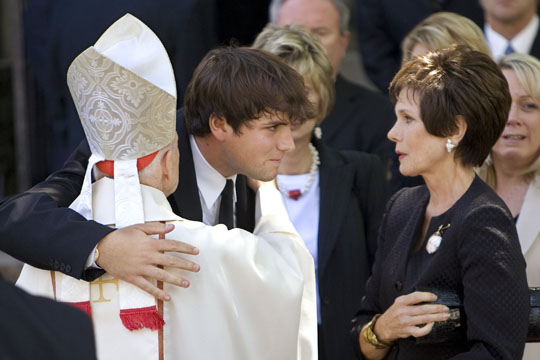
"As last winter’s congressional budget talks collapsed with the debt limit on the horizon, 27-year-old Luke Russert put the situation in perspective for MSNBC. 'I have never seen anything like it in my three-and-a-half years on Capitol Hill,' he declared with conviction. It was a moment teed up perfectly for Washington’s many Russert-haters, who love to point both to Russert’s lack of experience and what they see as his accompanying lack of humility. Russert was famously hired fresh out of Boston College by NBC News the same summer that his father, 'Meet the Press' legend Tim Russert, passed away suddenly—and many of his peers in the media have never forgiven him for it. 'I was Tim Russert’s wife for a really, really long time, and I don’t think I ever got the reaction that I get for being Luke’s mom,' said Vanity Fair writer Maureen Orth, who tweets under the handle @LukeRsMom. 'From the moment it was announced he would be working for NBC, which was his choice, but never planned for, ever, people just piled it on and piled it on and piled it on. And it was painful for me as a mother to see that.' Russert senior’s funeral, at which Luke spoke affectingly and with poise, is the opening set piece for Mark Leibovich’s This Town, which chronicles the city’s political-social strata in the Obama era. Leibovich calls Russert 'the mayor,' and writes that 'Tim possessed all of the city's coveted big-dog virtues: He was not to be fucked with. He seemed happy and excited and completely confident at all times, and why not? His killer persona combined a Guy's Guy exuberance with gravitas. Tim had a great table at the Palm and drank Rolling Rock from a bottle and ate good, manly food that wasn't drizzled with anything.'" (TNR)
"In fact, Jeremy Deller, who won the Turner Prize in 2004, is a hotshot – frequently described as one of the most important artists of his generation – and his work, which he calls 'social surrealism', is thought to have broadened the definition of contemporary art. Last year Joy in People, his much-lauded retrospective at the Hayward Gallery, included a documentary about fans of Depeche Mode; the remnants of a car bombed in a Baghdad marketplace, which Deller towed across America as a conversation piece; and a recreation of Valerie’s Snack Bar, a tea room in Manchester popular with pensioners, which was originally a float in a public procession organised by Deller to celebrate the city’s subcultures including goths, smokers and Big Issue sellers. As one admirer put it recently, Deller’s work is 'public art that has a genuine respect for the public'. At 46, he is now representing Britain at the 55th Venice Biennale – one of the greatest accolades, and challenges, for any artist ... Deemed untalented at art at school, Deller focused on art history, before attending the Courtauld Institute as an undergraduate. While there he went to an opening of a show at the Anthony d’Offay Gallery, where he met Andy Warhol, and was invited to spend two weeks at the pop artist’s Factory in New York. It was during that stay that he realised he wanted to be an artist himself and that, as he puts it, 'You could make art out of whatever you were interested in – you could run a magazine, make film, TV, prints, paintings, music production ... ' But becoming an artist took some time. 'I had no idea what I was doing basically,' he says about his twenties, when he took an MA in art history at Sussex University, lived with his parents and worked at jobs including postman, driver and shop assistant at Sign of the Times, a Covent Garden clothing shop for which he designed T-shirts featuring lyrics by Philip Larkin. For the Venice Biennale show Deller has had tote bags and invitations made which, printed in black letters on a bright pink background, read more like a warning than an advertisement: 'Please note that this invitation does not grant entry to the Giardini or guarantee entry to the British pavilion.' Deller explains it’s a joke about the exclusive, moneyed atmosphere at Venice, where it’s easy to feel like you’re on the wrong guest list or in the wrong restaurant. 'You’ve got to have a bit of fun or it overwhelms you,' he says. 'You’ll feel the weight of the country on top of you. People’s expectations of this show are huge.' A waiter arrives to take our order, and Deller orders sardines in saor (onion and vinegar marinade), followed by gnocchi with aubergine and fish. (Deller has, he says, been a vegetarian since reading Jonathan Safran Foer’s Eating Animals but eats fish 'when he has to'.)" (FT)
"On the eve of the 2012 White House Correspondents’ Dinner, this city’s annual media-politico-Hollywood love fest, Katharine Weymouth convened the sort of Washington power dinner for which her grandmother, Katharine Graham, the pioneering publisher of The Washington Post, was famous. Around the dining room table in Ms. Weymouth’s airy Craftsman home sat a collection of Kay Graham’s intimates and descendants: Vernon Jordan, the Clinton consigliere; C. Boyden Gray, counsel to the first President Bush; her oldest son Donald, now chief executive of the company that owns The Post; and Lally Weymouth, Mrs. Graham’s daughter and Ms. Weymouth’s mother, a globe-trotting journalist and Manhattan socialite known for both her interviews with Middle East dictators and glitzy Fourth of July Hamptons parties. At the head of the table sat Ms. Weymouth, a Harvard- and Stanford-educated lawyer, single mother of three and, at 47, a fourth-generation publisher of The Post. As her guests chatted, she gently intervened, steering the conversation, salon-style, toward the economy and presidential politics. When it was over, Mrs. Weymouth, not an easy one to please, showered her daughter with praise. 'It was a big moment,' said Molly Elkin, Ms. Weymouth’s best friend and one of the dinner party guests. 'It was sort of like: ‘I’ve passed the baton, kid. You’ve learned well, you did a good job.’' It was the kind of scene, rife with unspoken family drama, that captivates longtime Washingtonians, who have scrutinized and mythologized the Grahams for decades, much as the British do their royalty. Now, in an exceedingly difficult climate for newspapers, Ms. Weymouth is charged with saving the crown jewels. In a city and a clan filled with expectations for her, that is no easy task." (NYTimes)
"In fact, Jeremy Deller, who won the Turner Prize in 2004, is a hotshot – frequently described as one of the most important artists of his generation – and his work, which he calls 'social surrealism', is thought to have broadened the definition of contemporary art. Last year Joy in People, his much-lauded retrospective at the Hayward Gallery, included a documentary about fans of Depeche Mode; the remnants of a car bombed in a Baghdad marketplace, which Deller towed across America as a conversation piece; and a recreation of Valerie’s Snack Bar, a tea room in Manchester popular with pensioners, which was originally a float in a public procession organised by Deller to celebrate the city’s subcultures including goths, smokers and Big Issue sellers. As one admirer put it recently, Deller’s work is 'public art that has a genuine respect for the public'. At 46, he is now representing Britain at the 55th Venice Biennale – one of the greatest accolades, and challenges, for any artist ... Deemed untalented at art at school, Deller focused on art history, before attending the Courtauld Institute as an undergraduate. While there he went to an opening of a show at the Anthony d’Offay Gallery, where he met Andy Warhol, and was invited to spend two weeks at the pop artist’s Factory in New York. It was during that stay that he realised he wanted to be an artist himself and that, as he puts it, 'You could make art out of whatever you were interested in – you could run a magazine, make film, TV, prints, paintings, music production ... ' But becoming an artist took some time. 'I had no idea what I was doing basically,' he says about his twenties, when he took an MA in art history at Sussex University, lived with his parents and worked at jobs including postman, driver and shop assistant at Sign of the Times, a Covent Garden clothing shop for which he designed T-shirts featuring lyrics by Philip Larkin. For the Venice Biennale show Deller has had tote bags and invitations made which, printed in black letters on a bright pink background, read more like a warning than an advertisement: 'Please note that this invitation does not grant entry to the Giardini or guarantee entry to the British pavilion.' Deller explains it’s a joke about the exclusive, moneyed atmosphere at Venice, where it’s easy to feel like you’re on the wrong guest list or in the wrong restaurant. 'You’ve got to have a bit of fun or it overwhelms you,' he says. 'You’ll feel the weight of the country on top of you. People’s expectations of this show are huge.' A waiter arrives to take our order, and Deller orders sardines in saor (onion and vinegar marinade), followed by gnocchi with aubergine and fish. (Deller has, he says, been a vegetarian since reading Jonathan Safran Foer’s Eating Animals but eats fish 'when he has to'.)" (FT)
"On the eve of the 2012 White House Correspondents’ Dinner, this city’s annual media-politico-Hollywood love fest, Katharine Weymouth convened the sort of Washington power dinner for which her grandmother, Katharine Graham, the pioneering publisher of The Washington Post, was famous. Around the dining room table in Ms. Weymouth’s airy Craftsman home sat a collection of Kay Graham’s intimates and descendants: Vernon Jordan, the Clinton consigliere; C. Boyden Gray, counsel to the first President Bush; her oldest son Donald, now chief executive of the company that owns The Post; and Lally Weymouth, Mrs. Graham’s daughter and Ms. Weymouth’s mother, a globe-trotting journalist and Manhattan socialite known for both her interviews with Middle East dictators and glitzy Fourth of July Hamptons parties. At the head of the table sat Ms. Weymouth, a Harvard- and Stanford-educated lawyer, single mother of three and, at 47, a fourth-generation publisher of The Post. As her guests chatted, she gently intervened, steering the conversation, salon-style, toward the economy and presidential politics. When it was over, Mrs. Weymouth, not an easy one to please, showered her daughter with praise. 'It was a big moment,' said Molly Elkin, Ms. Weymouth’s best friend and one of the dinner party guests. 'It was sort of like: ‘I’ve passed the baton, kid. You’ve learned well, you did a good job.’' It was the kind of scene, rife with unspoken family drama, that captivates longtime Washingtonians, who have scrutinized and mythologized the Grahams for decades, much as the British do their royalty. Now, in an exceedingly difficult climate for newspapers, Ms. Weymouth is charged with saving the crown jewels. In a city and a clan filled with expectations for her, that is no easy task." (NYTimes)
Thursday, August 01, 2013
Media-Whore D'Oeuvres
"Coincidentally, a reader of the NYSD in Los Angeles, having read my report yesterday on the Gore Vidal, I Told You So book, sent me this message last night: 'In the last years of his life, I saw Mr. Vidal on a regular basis at the Polo Lounge (in the Beverly Hills Hotel). He was in a wheelchair and had a (very nice) male nurse. Gore would sit next to the piano player and sing standards and show-tunes for hours. He knew it was the end. When he sang, 'My Way', he very loudly emphasized the words "THE END IS NEAR, and so I face, the final curtain." Still, he seemed happy. He enjoyed talking to the people in the restaurant and would sometimes invite people back to his home to listen to opera. In the book of Vidal interviews ('I Told You So') he laments the loss of language and historical knowledge in the generations that have followed him, pointing out that the younger filmmakers have no sense of living, but more a sense of movies, which of course is not the same thing. It occurred to me that his singing those songs in public was not only a pleasure but another way for him to demonstrate the loss he was referring to." (NYSocialDiary)
" ... The 'different wings/' part of that is key. (Chris) Christie's (relative) social moderation and support for the (limited) power of government represents the old wing of the Republican party. (Rand) Paul's (relative) social conservatism and nouveau libertarianism is the new breed, an evolution of his Tea Party roots for the national stage. This is the sort of thing that often gets worked out in a presidential primary. In 2012, however, the party focused on getting rid of Barack Obama in lieu of identifying its own direction. Mitt Romney, from the Christie strain of Republicanism, tried on the Paul strain during the primaries. The mess that resulted needs no further explanation. But it meant that the party didn't try to bridge that gap, pushing off the debate until 2016. Which is why Christie and Paul have already taken it up. And it means that it's not really their fault. In a poll conducted by Pew Research released on Wednesday, that split is immediately apparent. Pew asked Republican voters about how the party is faring and how it might need to change. Three sets of responses are worth pulling out." (TheAtlantic)
"If I hear or read one more American hack mentioning the word 'democracy' regarding Egypt and the Middle East, I swear on Joe Biden’s hair-implanted head that I shall go in front of the Capitol and commit ritual seppuku, the Japanese warrior’s way of leaving this life. ... It took the editor of the London Spectator writing in the Daily Telegraph to get it exactly right. What the Arab world needs is capitalism, not democracy, Fraser Nelson wrote. The so-called Arab Spring began when Mohamed Bouazizi set himself on fire to protest the fact that he had to bribe Tunisian cops to sell his goods from a cart. It was as simple as that. A poor cart salesman immolated himself for capitalism, not democracy. Police had confiscated his fruit and a pair of scales once he refused to pay a bribe. That is all he had. He was not allowed to trade any longer, hence his suicide. Getting a license to trade, opening a shop, and even selling goods on the street need governmental approval. Bribes and bureaucracy go hand in hand. As Nelson wrote, 'traders do not really break the law—the law breaks them.' Sixty similar cases were overlooked by the geniuses of the press clamoring for democracy in the Middle East. But before I go on, a word about democracy, a most overrated and misunderstood institution that brain-dead reporters and so-called commentators use ad nauseam while reaching for the moral high ground. In what sense do you really have a hand in ruling the country through your vote? The sad answer is none whatsoever. Special interests and major corporations, yes; little John Doe, not at all. The demos, as the ancient Greeks called the people, practiced selective democracy, like we do in America with special interests. Mind you, the fairest way to ensure that everyone has an equal voice and chance to rule would be a lottery, but such a lottery would be rigged just as the game already is, so let’s drop that one." (Taki)
"Is politics a zero-sum game? Imagine, for a moment, if Sen. John McCain (R) had somehow won the presidency in 2008. How might the country be different? We would not have the Affordable Care Act. Sonia Sotomayor and Elena Kagan would not be on the Supreme Court. And the stimulus passed at the outset of McCain’s presidency would probably have been considerably different from the one passed under President Obama. Oh, and there’s this: Democrats would probably still control the House, and they’d certainly still control the Senate. That’s because the president’s party almost invariably pays a price for holding the White House, a price that can be measured in the loss of House representatives, senators, governors and state legislators. Take a look at Chart 1, which examines the electoral history of the 12 presidents who served after World War II. Generally speaking, presidents left office with their parties having smaller House and Senate caucuses than when they arrived, and also fewer governors and state legislative chambers — often dramatically fewer. All in all, these 12 postwar presidents lost an average of 30 U.S. House seats; six senators; eight governors; total control of six state legislatures; and about 360 state legislative seats over their tenures. That includes Obama’s losses, even though his final tally remains to be totaled." (SabatosCrystalBall)
"'Satanic AOR:' a combination unlikely to find favor with devil worshippers, FM enthusiasts, or just about anyone else. And yet that's how a member of Sweden's Ghost B.C. (the legally-mandated "B.C." is silent) described a song off their new album, Infestissumam, which scaled Billboard's Hard Rock and Tastemaker charts back in May. This is all the more impressive considering that five of the band's six members -- known only as Nameless Ghouls -- hide their identities behind black vestments and masks that look like they were stolen from Sleep No More patrons; singer Papa Emeritus II prefers corpse makeup, pointy hats and plenty of inverted crosses. Infestissumam, the follow-up to Ghost B.C.'s 2010 debut Opus Eponymous, is rich with curveballs and contradictions. The single 'Year Zero/' sounds like classic 1970s metal -- think Ozzy melodies and haunted-house organ -- set to the beat of 'Dancing Queen.' (And indeed, the band recently recorded a cover of ABBA's 'I'm a Marionette' with Dave Grohl.) Our Ghoul, when asked about the song "Body and Blood," cited influences as far-flung as Television and Kansas. The melodies are often spectacular, as is the production. Somehow, Papa and the Ghouls have transformed a bonehead concept -- the presence of the Antichrist here on earth -- into something vastly more satisfying. If the Kinks and Gwar got together and remade The Omen, they might well end up with Ghost B.C. As you can imagine, staying anonymous within an increasingly mainstream band is hard. So is sustaining a concept as specific as Satanism over more than a couple of albums." (Paper)
"Michael’s was its a-clattering Wednesday self. Herb Siegel was at his regular table 5 with his son Bill Siegel and another guest. Right next to him, Vartan Gregorian was lunching with the Ambassador to Afghanistan; next door was Gerry Byrne, Vice Chair of Penske Media with Maryann Halford, finance and digital media consultant; Simone Levinson was with our Deputy Mayor Patti Harris; CNBC’s Ron Insana; Harold Holzer, Senior VP at the Metropolitan Museum, occupied Table One which looked liked a powwow of a working (delicious) lunch. Interiors-interiors, Steven Stolman of Scalamandre with Tristan Butterfield of Kohler. (Steven was featured in this past Friday’s HOUSE interview); tabloid impresario David Pecker with David Zinczenko publisher of his newly re-launched Men’s Fitness, along with Diane Clehane. Clehane’s lunches are interviews and she’s assiduous in getting her story which is published later in the afternoon on mediabistro.com. Next to them, Micky Ateyeh and guests. Nearby: Endeavor’s Ari Emanuel, brother of Rahm, the Mayor of Chicago, with David Zaslav, prez of the Discovery Channel; Chris Meigher of Quest with Lesley Stevens of LaForce and Stevens public relations. Moving around the room, Jack Kliger of TV Guide; Bobby Friedman the guy who had lunch with Leo DiCaprio a couple of weeks ago; the irrepressible Jason Binn, publisher of DuJour ..." (NYSocialDiary)
"To Sergey Aleynikov’s new way of thinking, every American could benefit from some time in jail, but in the event that you are yourself actually arrested and sent away, “there are certain practical aspects to keep in mind.” First, dress warmly. Detention centers tend to be freezing cold, even in summer, and so if you happen to be wearing shorts or short sleeves you’re in for a spectacularly unhappy night. Second, carry no cash. “If you have money, they charge you a convenience fee,” he explains. “If you don’t have it, they don’t charge you. The less money you have on you, the better.” Third, memorize a couple of emergency contact phone numbers. On the night of his first arrest he discovered he didn’t actually know his wife’s cell-phone number. He’d always phoned her by name from his cell phone’s address book, but his phone was one of the first things they’d taken from him. The fourth, and final, rule was by far the most important: Don’t say a word to government officials. “The reason you don’t,' he says, 'is that, if you do, they can place an agent on a witness stand and he can say anything.' On the night of July 3, 2009, as he came off a flight from Chicago to Newark, New Jersey, he was totally unprepared, because he’d never imagined himself as the sort of person who might commit a crime. He worked too much and took only the vaguest interest in his fellow human beings, but, up to the moment of his arrest, Aleynikov had no sense that there was anything wrong with him or his situation. On the surface, his life had never been better: his third child had just been born, he had a new job at a hedge fund that paid him a million dollars a year, and he’d just moved into a big new house of his own design that he thought of as the perfect home. He’d come to America 20 years ago with little English and less money. Now he was living the dream. For much of the flight from Chicago he’d slept. Leaving the plane he had noticed three men in dark suits, waiting in the alcove of the Jetway reserved for baby strollers and wheelchairs. They confirmed his identity, explained they were from the F.B.I., handcuffed him, and walled him off from the other passengers. This last act was no great feat. Serge was six feet tall but weighed roughly 130 pounds: to hide him you needed only to turn him sideways. He resisted none of these actions, but he was genuinely bewildered. The men in black refused to tell him his crime. He tried to figure it out. His first guess was that they’d gotten him mixed up with some other Sergey Aleynikov. Then it occurred to him that his new employer, the legendary high-frequency trader Misha Malyshev, might have done something shady. Wrong on both counts. It wasn’t until the plane had emptied and they’d escorted him into Newark Airport that they told him his crime: stealing computer code owned by Goldman Sachs." (Vanity Fair/Michael lewis)
Tuesday, July 30, 2013
Why John Kerry Was Born To Be Secretary of State
![]() |
| John Kerry, doing the job he was born to do |
Even with all the shuttle diplomacy, the lack of time with his wife and family, the state of the world and the declining international reputation of the United States ... John Kerry looks ten years younger. He positively looks like he is having the time of his life.
John Kerry was an inept Presidential candidate, but he is fabulous Secretary of State. His energetic style -- especially when contrasted with Hillary, who took the job after a grueling campaign -- is astonishing. There is an energy -- quiet and sometimes ebullient -- that animates him in his new role as he strides the globe like a well-coiffed colossus. The fact that President Obama, who served on the Senate Foreign Relations Committee with him, is hanging back only adds to the impressiveness of the way in which Secretary Kerry has conducted himself in his tenure thus far. It almost looks as if he is handling the US foreign policy -- Arab Spring, Iranian nuclear ambitions, Middle East peace talks, Snowden and Putin -- all on his lonesome while the President battles with an intractable, tea-party infused Congress on the domestic front.
Let me re-state: Kerry was a terrible Presidential candidate. Really and truly, Kerry sucked ass on the campaign trail. His answers were convoluted and twisty, his air testy, aristocratic and haughty and he looked more at home sipping a Montrachet while listening to Grieg than drinking beer and watching the game. His hair may have been perfect for the role, but he was incapable of connecting with people in places like Iowa, like Colorado, in Ohio, in West Virginia and in Florida (places, we cannot fail to note, where he should have been more competitive). Windsurfing is par for the course for Ambassadors, but if you want to run for President, you have to learn to clear brush and watch football while munching pork rinds. John Kerry doesn't even like spicy food. What kind of an American does he think he is?!
Kerry's nuanced flip-flops are far better suited to the world of diplomacy -- of Richlieu, or Morganthau, and of, absolutely, Kissinger -- than to the retail democratic politics of kissing babies and not wind surfing.
His fellow Massachusetts pol Tip O'Neill once said, "all politics is local," but for John Kerry, all politics is international. On the campaign trail in 2004 he seemed more interested in a foreign policy agenda than in anything else. Even as he Chaired the Foreign Relations Committee from 2009-2013 he was campaigning, effectively, to become SecState. And when he was to be confirmed SecState, Kerry sailed through the Foreign Relations Committee, his old club. John Kerry's Machiavellian campaign against Susan Rice to succeed Hillary was masterful. Kerry almost certainly did not cry foul when his old Senate pal John McCain -- a swell guy, to be sure -- all but torpedoed her nomination. After that, Kerry was a lock!
Kerry was the son of an Ambassador, a "diplobrat." I know whereof I speak. I, too, was the son of an Ambassador. Diplobrats -- like Army brats -- are raised in many countries young and tend to be held to high standards by their parents. This does something. It has taken me years to figure it out. In many ways it makes such a person unable to be a good democratic politician. At an early age all diplobrats as well as all army brats learn that the world is a big and dangerous place. There is no such thing as "the neighborhood." The world is the neighborhood. There is no black and white -- only shades of gray. Fundamentalist views of the world are provincial and laughable.
John Kerry was fooling himself if he thought he could win certain states with that inborn attitude. He is a fine and energetic Secretary of State. this is the job he was born to do.
Media-Whore D'Oeuvres
"China has become a metaphor. It represents a certain phase of economic development, which is driven by low wages, foreign appetite for investment and a chaotic and disorderly development, magnificent in scale but deeply flawed in many ways. Its magnificence spawned the flaws, and the flaws helped create the magnificence. The arcs along which nations rise and fall vary in length and slope. China's has been long, as far as these things go, lasting for more than 30 years. The country will continue to exist and perhaps prosper, but this era of Chinese development -- pyramiding on low wages to conquer global markets -- is ending simply because there are now other nations with even lower wages and other advantages. China will have to behave differently from the way it does now, and thus other countries are poised to take its place ... There is no single country that can replace China. Its size is staggering. That means that its successors will not be one country but several countries, most at roughly the same stage of development. Taken together, these countries have a total population of just over 1 billion people. We didn't aim for that; we realized it after we selected the countries. The point to emphasize is that identifying the PC16 is not a forecast. It is a list of countries in which we see significant movement of stage industries, particularly garment and footwear manufacturing and mobile phone assembly. In our view, the dispersal of industries that we see as markers of early-stage economic growth is already underway. In addition, there are no extreme blocks to further economic growth, although few of these countries would come to mind as having low political risk and high stability -- no more than China would have come to mind in 1978-1980. I should also note that we have excluded countries growing because of energy and mineral extraction. These countries follow different paths of development. The PC16 are strictly successors to China as low wage, underdeveloped countries with opportunities to grow their manufacturing sectors dramatically. The new activity is focused on Africa, Asia and to a lesser extent, Latin America. When you look at map, much of this new activity is focused in the Indian Ocean Basin. The most interesting pattern is in the eastern edge of Sub-Saharan Africa: Tanzania, Kenya, Uganda and Ethiopia. Sri Lanka, Indonesia, Myanmar and Bangladesh are directly on the Indian Ocean. The Indochinese countries and the Philippines are not on the Indian Ocean, and even though I don't want to overstate the centrality of the Indian Ocean, they are nearby. At the very least we can say that there are two ocean basins, the Indian Ocean and the South China Sea. You might want to read my colleague Robert D. Kaplan's book Monsoon on this region. There are some countries in Latin America: Peru, the Dominican Republic, Nicaragua and Mexico. A special word needs to be included on Mexico. The area north of Mexico City and south of the U.S. borderlands has been developing intensely in recent years. We normally would not include Mexico but the area in central-southern Mexico is large, populous and still relatively underdeveloped." (STRATFOR)
"In 2011, Huma Abedin had support from her friends and Clinton associates when she decided to stay with her husband, scandal-plagued New York City mayoral candidate Anthony Weiner.The past week, that support has morphed into concern. Their worry is as much about what she is going through personally — a rapid turn from years of glowing media coverage of Abedin to front pages questioning her judgment — as it is about her decision to stand by and encourage politically a husband who several Democrats now believe is way past the point of redemption. Abedin, Hillary Clinton’s top aide and the wife of mayoral candidate-turned-national-joke Anthony Weiner, has become the focus of media coverage that’s gone, in short order, from sympathetic to savage. She remains in charge of running Clinton’s transition team, a slim staff of about a half-dozen aides, some of whom have other jobs – though she is a full-time employee. The feelings about Weiner in Clintonland are unequivocal, according to one someone close to the couple: 'Everyone’s done with him.' Multiple sources familiar with the Clintons’ thinking said they would be delighted for him to disappear from public consumption. (The fact that Weiner, who began the campaign name-dropping Bill Clinton repeatedly, declared at a mayoral forum Monday night that he wasn’t overly concerned with the opinion of non-New York City residents like the Clintons probably didn’t help). The feelings are far more complicated and emotional about Abedin, who actively encouraged her husband to run for mayor and who has spent her entire adult life working in some capacity for the Clintons. 'Everyone loves her to death,' said a Clinton ally who’s worked with her. Abedin did not give Clinton a personal heads-up that she planned to defend her husband at a hastily-called press conference last week. Still, Clinton was aware ahead of time that she planned to do it, having been alerted from others in her orbit, sources said. There are no current plans for the Clintons to ask Weiner to bow out of the race, although several of their allies have made clear how they feel about him. For them to do so formally would tether them to a publicity train wreck." (Politico)
"This past weekend I read 'I Told You So; Gore Vidal Talks Politics/Interviews with Jon Wiener.' The opening page after the copyright page contained the quote of Gore: “The four most beautiful words in our common language: I told you so.” The blurb on the cover has a quote by Dick Cavett: 'Best talker since Oscar Wilde.' Although Mr. Cavett couldn’t have been around when Wilde was propounding his poetic wit for any and all to listen to. I never imagined what that would have been like until I read Cavett’s quote. Because Gore Vidal is endlessly interesting on a number of levels ... If you like Gore Vidal, you will not be disappointed. If you don’t like Gore Vidal, you shouldn’t waste your time. When we read with rancor we deprive ourselves of truth.Then after the Vidal interviews — it was a quick read, a very nice little book; like watching it on TV with no noise in the room — after that one I picked up the new 'My Lunches with Orson; Conversations between Henry Jaglom and Orson Welles.' Edited by Peter Biskind. If you’re a fan or an historian of movie lore, or even if you just like watching those great old movies on TCM. Like a compulsive habit; buy this book. Orson Welles at table. I once saw him there. He was the size of the table — round table — sitting in a tiny nook of a private room, separated from public view by a curtain in the old Ma Maison on Beverly Boulevard. Dressed all in black, vast in size, somewhat darkly menacing yet oddly sorrowful in presence, it was almost like Hollywood noir come to life; 'The Third Man' sixty years later. I moved along that day I saw him, knowing I wasn’t supposed to be there." (NYSocialDiary)
"America was stunned when 'poor little rich girl' Casey Johnson, the troubled first-born daughter of billionaire New York Jets owner Woody Johnson, was found dead at age 30 in January 2010.
The Band-Aid heiress had been cut off from her fortune and family, whose help she refused. Her death from complications of diabetes sadly ended a short but scandalous life. Now, Casey’s turbulent world is ex-amined in JERRY OPPENHEIMER’S new bombshell unauthorized biography, 'Crazy Rich: Power, Scandal, and Tragedy Inside the Johnson & Johnson Dynasty.' Casey’s socialite mother, Sale Johnson, along with relatives and friends, spoke candidly for the first time since her death. Now, in an exclusive excerpt, Oppenheimer paints an astonishing picture of the doomed heiress and the role her mother and father played in their daughter’s life and tragic end . . . " (NYPost)
"Thirty years ago this past week, Sire Records released Madonna's debut album. Although it only created one pop icon, Madonna the album was the culmination of months of effort by diverse artists, photographers, executives and musicians. 'The first new wave disco music,' as one of her friends described it, carried plenty in its DNA: bouncy R&B grooves; traces of the last gasps of the pre-AIDS Downtown NYC culture; and, of course, the force of personality of the future Queen of Pop.
In early 1982, Madonna was 23 years old. In the four years since leaving Detroit for New York City, she'd earned her starving-artist bona fides, working at a Dunkin Donuts, sleeping in an abandoned Queens synagogue and rocking studded bracelets, ripped jeans and bleached, cropped hair ... Reggie Lucas: 'When Warner Brothers called me about working with Madonna, I was the big score. It seems ridiculous in retrospect, but I was an established professional and she was a nobody. I met with her at a tiny little apartment she had in the Lower East Side. I thought she was vivacious and sexy and interesting, and had a lot of energy. I signed on to do the record, and then 'Everybody' came out and it made a little noise. It sold 100,000 copies, so I was like, 'All right! This artist became a somebody before I even started on the album.' So that was nice, that was encouraging. Most of the people around Madonna at the corporate level did not get her and for the most part did not like her. You could see them recoil from her bohemianism. Everybody thought she was crazy and gross. I would never say she was a punk rocker, but she used to wear little boys' shorts, and white t-shirts with holes in them, and then she had little ring things in her ears. She wasn't the weirdest person I'd ever met, you know? I'd worked with Sun Ra! So after hanging out with the Heliocentric Worlds of Sun Ra, Madonna didn't seem particularly avant-garde. Michael Rosenblatt: While Reggie was making the record, nobody at Warner Brothers gave a shit at all. Madonna was just a little dance girl. Reggie Lucas: She was poor. She borrowed Jean-Michel Basquiat's apartment while he was in Paris, and so I spent a good hour and a half during the record meeting with her at Basquiat's place. He had his art up there, nobody knew who he was." (RollingStone)
"Word is going around New York that Leonard Lauder will marry his friend, the lovely Linda Johnson, President and CEO of the Brooklyn Public Library, on August 18th. The family knows; everyone has met, and everyone couldn’t be happier for the couple. So too their many friends. Now, to move to the other side of the marital universe, the Divorce Bel Air Style. Robert Day, the billionaire Superior Oil heir and international investor, is divorcing his beautiful wife Kelly. The Days have been married for a number of years, and quite happily according to close friends. But evidently Mr. Day, who is from one of the rich oil families of Los Angeles, the grandson of William Keck (who founded Superior Oil), a man who is now celebrating his 70th year, wants to go it alone ..." (NYSocialDiary)
Subscribe to:
Posts (Atom)